10 Reasons to Adopt a Cat

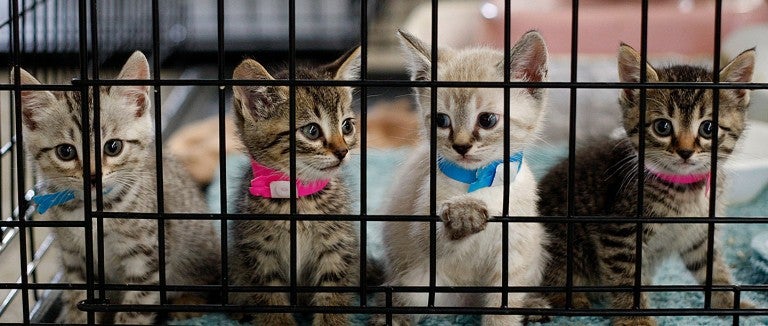
Cats make up approximately 70% of shelter population. It’s sort of obvious what you should do…ADOPT! Don’t Shop! There are many advantages when it comes to adopting cats from shelters. Many are already spayed or neutered. They are also current on their shots. Shelter volunteers are there for one reason: the good of the animal. They aren’t interested in a profit and any donation you make goes right back into helping more animals in need. I love cats, how about you?

by Julie E.H., Animal Rescue Site blog
theanimalrescuesite.greatergood.com

Why Do I Inconvenience Myself to Help an Animal in Need?

56149118_3d9b94d590Why do I inconvenience myself to help an animal in need?  I’ve been known to be late for meetings, wading into the field alongside the road to call a skinny, scared dog to me and deliver him to the SPCA so that he can be helped, reunited with his owners or placed in a caring home.  I’ve been known to humanely trap a feral cat, have her spade, release her, and provide ongoing food, water, and shelter to her.  I’ve been known to adopt a rescue cat, a rescue dog.  I’ve been known to telephone for help and wait by the side of an struggling, car-struck deer until animal control arrives to put it out of its misery.  I’ve been known to contribute to neutering costs for people in financial hardship.  Why, I’ve been asked, why?

The reason:  because I feel deeply, can empathize with the feelings of others, and I care about the suffering and experience of individual animals.  Of course animals can feel pain and fear.  Of course they can suffer.  I have a commitment to myself to do what I can to help, and it turns that with minimal effort, I can do a lot more than I originally thought I could.  Doing so allows me to live in peaceful alignment with my values.  Yes, it can be a nuisance at times, but it’s worth it.  In the bigger picture, it doesn’t require that much of me, really, to help a creature to experience less pain, less hunger, less thirst, less bitter cold.

What if each of us committed to helping an animal in need?  It’s so much easier to turn away, but that small sense of satisfaction that comes from bringing relief to another sentient being is a reward in and of itself.  I am immensely grateful for the ability not to turn away.


Humans Defending Animals from Other Humans

All animals illustration ID-10040124AnimalPetitions.org, part of the ForceChange.com network, is dedicated to protecting both wild and domestic animals from abuse and harm at the hands of humans. The Animal Petitions community is comprised of passionate citizen activists dedicated to taking action to protect animals.  The activism?  Simply sign your name to petitions with messages you value.

AnimalsPetitions.org has contributed to a number of successes, including conservation funding for wild animals, tightened puppy mill laws, animal welfare law passage in Thailand, reenlistment of gray wolves as an endangered species, CEO resignation over animal abuse, and more.

Please consider signing your name (they do not share emails–I know this from personal experience).  http://animalpetitions.org/

Thanks,
Carolyn
Wild & Domestic Animals illustration courtesy of Vlado, freedigitalphotos.net


2014 Victories for Animals Worldwide and in the US

You Can Save This Iraqi Kitten…Really

SPCA International
Picture 22Mike believed he would never see Lani again. When this ex-Marine left Iraq… he had to leave behind the little kitten he raised after finding her crying, alone in a gutter. Mike’s heart broke last June when he said goodbye to Lani. He thought she’d never survive Iraq without him. He was her protector. She was his best friend.But Lani DID survive. Mike’s buddy at the U.S. consulate recently emailed him and told him he’d seen Lani hanging around. This is the miracle Mike thought would never happen. And I can tell you that right now he’s hoping, praying that you will help him save the cat he loves from that miserable place and bring her home to him in the U.S.Yes, Lani is alive. We must rescue her and 17 other dogs and cats BEFORE June 1st. That’s when the airlines start their heat embargo in the Middle East. And we still haven’t raised enough money to get there, get every dog and cat, and get back home. If we’re not able to fund our mission, they face death. Maybe they won’t die today or next week. But believe me, it will happen. If not from the blistering heat, then from starvation or from torture at the hands of the locals. It doesn’t have to end that way. You can make sure they live by giving today.This is the moment that Mike– an ex-Marine who has bravely served and sacrificed, has been waiting for. I’m asking you to do what he wasn’t able to do last June – save his adorable kitten, Lani. Please give right now so that we can go to Iraq BEFORE the deadline of June 1st.   To DONATE $5 OR WHATEVER YOU CAN:  {click one line down if link is not visible} https://www.2dialog.com/spcai/main.php/micro_sites/showpage/id/44/package_id/1436/page_number/1With hope,

JD Winston
Executive Director
SPCA International

P.S. Mike will never see Lani again if we don’t go rescue her from Iraq before the June 1st heat embargo. Will you please give now – whether it’s $100, $50, or even $5 to save this little cat from certain death in Iraq? Thank you so, so much.

An Urban Intervention to Make the Invisible Visible

Shelter – part 4

© Karla McLaren 2014

As the third round of the greet-and-treat begins, I change my normal pathway through the kennels, and crouch down and whisper to the dogs I treat on my way down the T-leg toward Nana’s – so that she can’t see me coming. As I reach her kennel, still crouched down, I catch her, standing up and peering over her wall, waiting for me. I speak quietly as I stand up, “Hello, you criminal!” and Nana makes a noise that sounds just like Scooby Doo getting caught with a sandwich, “oirp?” Hah! She drops down from her perch, sits properly and quietly, and looks at me with sparkling eyes. ”Good girl Nana, down,” I say. I throw my voice a bit to the dogs near her who are unusually quiet, for once, “Down and quiet, good dog!” Nearly everyone in Nana’s area gets a third-round treat today (for the first time), and as I pass her on my way back, I give her another treat, the outlaw.

The third round goes well, with more than half of the dogs figuring out all three behaviors: seated, still, and quiet. It’s still very noisy; we have a lot of new dogs who are afraid and riled up – but even in the midst of the noise, many dogs are getting the picture and learning how to calm themselves in spite of the clamor. As I continue through the shelter, I take a moment at Peaches’ kennel: the little sweetie has mastered two out of three behaviors. She’s quiet and calm, but she’s still down on the floor, and I don’t actually think she can sit, so I open her kennel door. I carry a leash with me in case dogs need to come out of their kennels for some reason during the greet-and-treats, but I don’t think Peaches can walk, so I close myself in her kennel with her to see what’s going on.

Peaches lifts her head happily and then flips over on her tummy and wriggles nearer to me, and I sit down to be with her. Peaches is a love: soft, cuddly, and wanting to be picked up. As I lift her, she struggles a bit to get herself into my arms, and she curls up like a baby, nuzzling and kissing me. I hug her and kiss her, and talk sweet nonsense to her as I run my free hand over her legs and feet: her front legs seem normal, but both of her back legs are floppy, and they have almost no muscle tone. They’re also pointing backward, which explains her seal movements and her inability to sit. I also gently palpate her umbilical hernia, and she doesn’t yelp or pull away, so it doesn’t seem to be hurting her. I wonder why she’s up front instead of back with Jake and Milton, but she’s so adorable that I think the staff is hoping she’ll be adopted before they start on her surgeries. If I could have a dog, I would totally take Peaches; I think they’ve made a good call.

After a few minutes of kissing and snuggling, I leave Peaches with extra treats and let myself out of her kennel. All of the dogs nearby have been quiet and patient as they watched me in Peaches’ kennel (including, unbelievably, the terriers), so they all get another treat. I head back to the chained-off area, but I see Brandon (one of the staff behaviorists) there, uh oh. He’s taking one of the other T dogs out into the private training area to check her temperament. I hope he doesn’t see the treats I gave Milton, oy.

I loiter around the chain and wait for Brandon to take his T dog outside. When he does, I duck under the chain and peer into Milton’s kennel, and I don’t see any treats – not the one on the blanket, and not the one on the bottom of the kennel door where I left it, whew. However, I also don’t see Milton, and I feel a bit of panic – did they take him? I call to him and kneel down to peer through the small opening that leads to his run, but I don’t see him. I look for Jake, but he’s not in his kennel either. I run (okay, I walk quickly but calmly, so the dogs won’t start barking again) back through the kennels, into the back rooms, past the laundry room overflowing with blankets, towels, and dog beds, and into the small room where the animals are euthanized. The room is empty, and Milton isn’t anywhere. I can’t shake my dread.

I walk back out into the kennels and head to the private training area to ask Brandon what happened, but when I get outside, I see him with Milton, who’s off leash and playing (!) in the sunshine with the female T dog. I feel a huge sense of relief, but I play it cool, “Oh hey, you’ve got Milton out again.” Brandon answers, but keeps his focus on the dogs, “Yeah, he’s such a smart dog that it didn’t feel right, redlining him. It was bugging me all night, and today he seemed to get that he had another chance.” I watch Milton running around, twisting, playing, and chasing the other dog, and they begin running around in circles, racing, faking each other out, and escaping from each other. I become a base in their game of tag, and Milton circles me twice before running off, happily engrossed in the game. I stand where I am, breathing deeply. Vast mountains of laundry call to me, but I turn my smiling face to the sun for a moment, and let the tears fall.

for part 1: https://untoldanimalstories.org/2014/03/07/shelter/
for part 2: https://untoldanimalstories.org/2014/03/14/shelter-part-2/
for part 3: https://untoldanimalstories.org/2014/03/21/shelter-part-3/

for all Untold Animal Stories: www.untoldanimalstories.org

Karla McLaren is a pioneering educator and award-winning author whose empathic approach to emotions revalues even the most “negative” emotions, and opens startling new pathways into the depths of the soul. She is the author of The Art of Empathy: A Complete Guide to Life’s Most Essential Skill, the trailblazing book The Language of Emotion: What Your Feelings Are Trying to Tell You, and the interactive online course Emotional Flow. Karla has taught at such venues as the University of San Francisco, Naropa University, Kripalu, and the Association for Humanistic Psychology. She is currently developing new forms of empathy and social interaction curricula for neurologically diverse people.

The Art of Empathy

What if there were a single skill that could radically improve your relationships and your life? Empathy, teaches empathic pioneer Karla McLaren, is that skill. In The Art of Empathy: A Complete Guide to Life’s Most Essential Skill, McLaren presents her groundbreaking model of The Six Essential Aspects of Empathy to help you understand and nurture healthy empathy in every part of your life.  Informed by four decades of empathic experience, plus current insights from neuroscience, social science, the arts, and healing traditions, The Art of Empathy teaches you how to become a healthy and happy empathic presence in a world that needs you.

Ollie & Spuds – Chapter 2

(continued from previous post)   The cat’s name is Spuds.  The old man she’d lived with thought she looked like the color of yellow Finn potatoes.  He’d pulled her as a kitten out from under a bramble—mewing and shaking—on a busy roadside.  He gently stroked her fur with large, rough hands, looked into her gold-green eyes, and took her home.

Spuds had a life of luxury with him: curled up on the rug by the wood stove in winter, lounging on a sunny perch on the screened-in porch in the summer watching red cardinals and blue birds.  Spuds liked the old man, a lot; they understood each other.  But one morning when she went up to his room to remind him it was feeding time, something was different.  She jumped up on the bed and stood on his chest and peered at him.  She could sense him, but he wasn’t in there his body.  She called out to him.  Then she saw him in her mind’s eye, and his eyes were dazzling.  Then he receded and was gone.

Four days passed before anyone came to the house.  By then Spuds had clawed her way through the bag of cat food and found that fresh toilet water wasn’t completely undrinkable.

People came then, many of them, people who had never come before.  They pawed the old man’s possessions, argued with each other, and carried things out of the house.  Spuds watched.  A woman noticed the cat and picked her up, bangle bracelets clanging together, and put Spuds outside.  Spuds sniffed at the air, then turned to go back inside.  The woman blocked Spuds’ way with a well-shod foot.  “You’re free now kitty, go away.”

Spuds looked for a long while at the closed door.  Then she walked down the driveway and before turning onto the road, looked back at the house.  The windows glinted empty and cold in the sun.
Ollie & Spuds will be continued

Chapter 1: https://untoldanimalstories.org/2014/02/15/ollie-spuds-chapter-1/

Chapter 3:  https://untoldanimalstories.org/2014/05/04/ollie-spuds-chapter-3/

25 Ways to Help Animals & the Humane Society International

From helping animals affected by disasters, providing care for starving street dogs in India and elsewhere, making strides for animals in laboratories, factory farms, puppy mills, and so much more, Humane Society International (HSI) is working to protect animals around the world Please visit their site and consider a small holiday donation in honor of someone you love.   Thank you.  http://bit.ly/1g9QZhL

child with dog ID-10023413

25 Actions to Help Animals and HSI

There are many ways to show that you care.  Get involved, make a difference.  Here are 25 ideas for ways you can help animals locally and around the world.

With so many widespread problems facing animals, it takes all of our collective efforts to confront cruelty and change things for the better.

Get involved in your community

  • Write letters to the editor on animal protection issues and encourage radio and television talk shows to cover these topics (hsi.org is a great resource for information).
  • Approach your place of worship about engaging in animal protection issues. See what the HSUS Faith Outreach team has been doing for ideas.
  • Help feral cats in your neighborhood with the HSUS’s Trap-Neuter-Return (TNR) resources.
  • Ask your local restaurants and grocery stores to switch to cage-free eggs, and to protect seals by boycotting Canadian seafood.
  • Take a stand against puppy mills and encourage local stores that sell live animals to stop. Ask pet stores to work with animal welfare organizations to promote animals available for adoption.
  • Promote Meatless Mondays in your school, workplace cafeteria, or in your favorite restaurant. It’s a campaign that’s good for animals, the environment, and our health.

Help animals in your everyday life

  • Be a responsible pet owner. Have your pet spayed or neutered to prevent unwanted births. Put a collar and visible identification on your dogs and cats and encourage others to do the same. And keep your cats safe indoors.
  • Avoid supporting cruelty as “entertainment.” Do not attend bullfights, bull fiestas, or marine mammal shows.
  • Add an HSI video to your website, blog, or social networking page.
  • Educate yourself by signing up for email action alerts and news from HSI. Share emails with friends.
  • Adopt a friend for life from a local animal shelter or foster an animal waiting for a permanent home. Search World Animal Net’s directory and choose “Pet Adoption” or “Foster Homes” under “Select Focus or Activity.” If you live in the U.S., search The Shelter Pet Project.
  • “Like” HSI on Facebook and follow us on Twitter.
  • Eat with conscience. Practice the 3 Rs of eating. Reduce your consumption of meat and other animal-based foods, refine your diet by avoiding animal products derived from factory farming, and replace meat and other animal-based foods with vegetarian options.
  • Pledge to be cruelty-free and only purchase cosmetics that are certified [PDF] to be non-animal-tested.
  • Support compassion in fashion by consulting the Fur-Free Retailer program’s list of fur-free retailers, designers, and brands and The HSUS’s guide [PDF] to telling real fur from fake.
  • Prepare a disaster kit for you and your animals.
  • Make compassionate purchasing decisions while traveling and at home with the help of our Don’t Buy Wild guide.
  • Ask restaurants that serve shark fin soup to stop by providing restaurant managers with our Consumer Cards.
  • Make a personal annual gift to HSI or sign up for an automatic monthly pledge using your credit card.
  • Share this list with family members and friends so they can learn how their actions can help animals, too.

Participate in trainings and events

Volunteer for animals

  • Offer your time and skills to your local animal welfare/protection organization. A useful resource is the World Animal Net directory. Do make sure you are comfortable with the positions and actions of any group you volunteer for. You can also volunteer ”virtually” for groups anywhere in the world!!
  • Some ways you may be able to help animal protection organizations: fundraise, manage their website or social media presence, design and produce flyers and/or advertisements, set up a community education booth [PDF], or take photographs of animals available for adoption.

Reach out to youth and schools

  • Teach children and teens to respect animals with humane education activities and lesson plans. Lead Mission: Humane projects for students and animal clubs who want to help animals.
  • Provide classrooms and youth clubs with our How to Avoid Dog Bites booklet [PDF]
  • Give talks at local schools about factory farming and how students can help animals at every meal by avoiding factory farmed products, and by choosing cage-free eggs and plant-based foods. Encourage them to ask their cafeterias to go cage-free and to adopt Meatless Monday.

Information from http://www.hsi.org and letter from Rebecca Aldworth, Executive Director of HSI Canada on My Life’s Work – Helping Animals

Photograph of Child with Dog courtesy of freedigitalphotos.net and photographer Ashley Cox

Part IV … in the middle of winter

Gracie in windowFor part I:   https://untoldanimalstories.org/2013/09/13/i-was-born-in-the-middle-of-winter/
Part II:
https://untoldanimalstories.org/2013/09/20/part-ii-i-was-born-on-an-amish-farm-in-the-middle-of-winter/
Part III: https://untoldanimalstories.org/2013/09/27/part-iii-i-was-born-on-an-amish-farm-in-the-middle-of-winter/

I was not born on an Amish farm in the middle of winter, but I live with the one who was.  I was born in the middle of summer in Peachbottom, PA, near a chain link fence.  By the time I was six months old I’d had a litter of kittens.  At eight months, someone tossed me from a car window by my forearm.  I walked with a limp like Quasimodo for a long time.  I landed in a soft place eventually, but that’s another story for another time.

This part of my story is about Mr. Bean, who blasted into my life after we lost our dog, Beez.  Beez and I were best of friends, and now he’s gone.  Beezel & Gracie 2009My people adopted this wiry, wild-eyed kitten who lacks manners.  Though our pasts have similarities—each of us was neglected and suffered from hunger—I’m more philosophic than Bean is.  I see things as they are, and I soften into them.  Despite Mr. Bean’s behavior toward me, I conduct myself exactly as I chose to be.  I never bite.  I am kind, always.  I live peacefully.  It’s my hope that by walking my path, I will teach this young one.  In the meantime, I’m chased, pounced upon, and chewed on.  If I could sigh, I would.  But things are exactly as they are, and I move through my world in relative serenity, sometimes better than others.

DSC_0106

Feedback . ideas . rescue stories   

Go back

Your message has been sent

Warning
Warning
Warning

Warning.