What Kind of Emotions Do Animals Feel?

A book by primatologist Frans de Waal suggests that animal and human emotions are more similar than we think

from: https://greatergood.berkeley.edu/article/item/what_kind_of_emotions_do_animals_feel

By Karin Evans

In a Netherlands zoo, an elderly chimpanzee named Mama is weak and dying. Elderly biology professor Jan van Hooff, who has known the primate for four decades, enters Mama’s enclosure—something usually too dangerous to attempt, given the strength of chimpanzees and their capacity for violent attacks. In their final, poignant encounter, she grins and reaches for him, embraces him, and rhythmically pats the back of his head and neck in a comforting gesture that chimpanzees use to quiet a whimpering infant.

“She was letting him know not to worry,” writes Frans de Waal in his new book, Mama’s Last Hug: Animal Emotions and What They Tell Us About Ourselves.

As one of the world’s most prominent primatologists, de Waal has been observing animals for four decades now, debunking myths around the differences between animals and humans. His latest book focuses on the emotional lives of animals—showing that humans and other animals may be more alike than we think.

Like de Waal’s other books, Mama’s Last Hug is full of stories, making it highly readable, informative, and emotionally resonant. In another story he recounts, a younger female in Mama’s colony, Kuif, couldn’t produce enough milk to keep her babies alive; so de Waal taught her how to feed an adopted infant with a bottle. Kuif turned out to be a caring and protective mother, learning on her own how to remove the bottle when the baby needed to burp. Afterward, each time de Waal approached Kuif, she showered him with affection and expressions that truly seemed like gratitude.

After Mama’s death, de Waal witnessed the other chimpanzees touching, washing, anointing, and grooming her body—gestures very similar to what humans do after a death. Given such observations of chimpanzees, de Waal asserts, “Their socio-emotional lives resemble ours to such a degree that it is unclear where to draw the line.”

Non-primate animals show emotions, too

While de Waal begins his observations with chimpanzees, he also presents fascinating glimpses of the emotional lives of other animals. For example, Asian elephants wrap their trunks around each other as an expression of consolation. Even rodents, once thought to be unaffected by emotions and devoid of facial expressions, have been found to “express anguish through narrowed eyes, flattened ears, and swollen cheeks.” They also have facial expressions for pleasure, and they recognize these states in other rats. As for horses, De Waal notes that their faces are “about as expressive as those of the primates.”

In dogs, a key facial expression—the “inner-brow pull”—makes their eyes appear larger. This gives them that sad, puppy-like look that pulls at the heartstrings of humans, sometimes leading to canine adoptions. De Waal also digs at an oft-asked question: Do dogs feel shame when they do something wrong? It reminded me of online videos where you see garbage overturned and a dog slouched down, staring at the floor in a way that viewers interpret as “guilt.”

“No one doubts that dogs know when they are in trouble,” writes de Waal, “but whether they actually feel guilty is a point of debate.” According to a study by Alexandra Horowitz, the canine guilty look—“lowered gaze, ears pressed back, slumped body, averted head, tail rapidly beating between the legs—is . . . not about what they have done but about how their owner reacts. If the owner scolds them, they act extremely guilty. If the owner doesn’t, everything is fine and dandy.”

De Waal draws a clear distinction between animal behaviors that connote emotions readable to outside observers and what animals actually feel.

“Anyone who claims to know what animals feel doesn’t have science on their side,” he writes. “Emotions and feelings, while often conflated, are not the same.” Emotions drive behavior and come with physical cues that allow them to be observed and described; feelings are internal subjective states known only to those who possess them.

So, though de Waal views elephants as highly empathic, emotional beings—given how they will rush to comfort a fellow elephant in distress, and how they can recognize themselves in a mirror—he acknowledges that some scientists remain skeptical because we can’t ask elephants (or any animal) about their feelings. “The possibility that animals experience emotions the way we do makes many hard-nosed scientists feel queasy,” de Waal points out, “partly because animals never report any feelings, and partly because the existence of feelings presupposes a level of consciousness that these scientists are unwilling to grant to animals.” 

What animals can teach us about ourselves

As de Waal explores human and non-human emotional territory, he finds considerable common ground. Bonobo babies who are orphaned and raised without maternal love suffer just as human babies do when similarly deprived. Orphaned bonobos have trouble regulating their emotions, whereas bonobos who grow up with maternal affection learn how to weather upheaval. And, just like humans, bonobos who haven’t been nurtured also have trouble comforting others who are in distress.<img alt="Mama’s Last Hug: Animal Emotions and What They Tell Us About Ourselves (W. W. Norton & Company, 2019, 336 pages)” src=”https://ggsc.s3.amazonaws.com/images/made/images/uploads/Mamas_Last_Hug_200_301_int_c1-1x.jpg&#8221; srcset=”https://ggsc.s3.amazonaws.com/images/made/images/uploads/Mamas_Last_Hug_200_301_int_c1-1x.jpg 1x, https://ggsc.s3.amazonaws.com/images/made/images/uploads/Mamas_Last_Hug_332_499_int_c1-2x.jpg 2x”>Mama’s Last Hug: Animal Emotions and What They Tell Us About Ourselves (W. W. Norton & Company, 2019, 336 pages)

“For me,” de Waal writes, “the question has never been whether animals have emotions, but how science could have overlooked them for so long.”

Just as de Waal’s book makes readers more attuned to the emotional life of animals, it gives us more than enough to ponder about our own human emotions.

As de Waal compares human behavior to our closest relatives’, he finds much to observe and report. The human smile, for instance, may be linked to the nervous grin found in other primates. “I seriously doubt that the smile is our species’s ‘happy’ face, as is often stated in books about human emotions,” he writes. “Its background is much richer, with meanings other than cheeriness.” Instead, a smile could mean nervousness, a desire to please, amusement, or attraction. 

Additionally, we humans “often wear plastic smiles with no deep meaning whatsoever.” How do you tell which is which? Studies by 19th-century French neurologist Duchenne de Boulogne identified two kinds of human smiles: The genuine version, an expression of positive feelings and joy, is known as the “Duchenne smile” and involves not only lifting the mouth corners and pulling back the lips, but pulling back the muscles around the eyes, resulting in narrowed eyes and wrinkled surrounding skin. A “fake” smile involves the mouth area but not the eyes—a useful distinction to know!

In considering current events, the author identifies two driving forces behind human politics: leaders’ lust for power and followers’ longing for leadership. De Waal observes that hierarchical battles occur in groups of humans as well as in groups of apes, with bullying tactics used by “alpha males” in both. “Like most primates, we are a hierarchical species,” he concludes.

Yet humans shrink from admitting that about themselves, he points out, preferring to describe themselves in gentler, more rarified terms. De Waal writes, “This is why it is so refreshing to work with chimpanzees: They are the honest politicians we all long for.”

Instead of considering ourselves so refined and rational, he suggests, it’s time for us to squarely face the degree to which we—like other animals—are driven by emotions.
Looking the Other Way

Never, never be afraid to do what’s right, especially if the well-being of a person or animal is at stake. Society’s punishments are small compared to the wounds we inflict on our soul when we look the other way” – Author Unknown 

How this rapper quit his music career to start a cat rescue

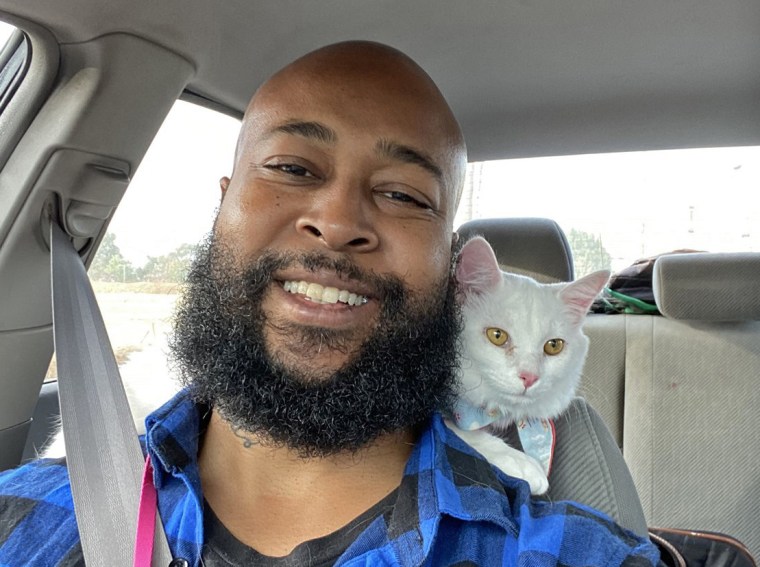
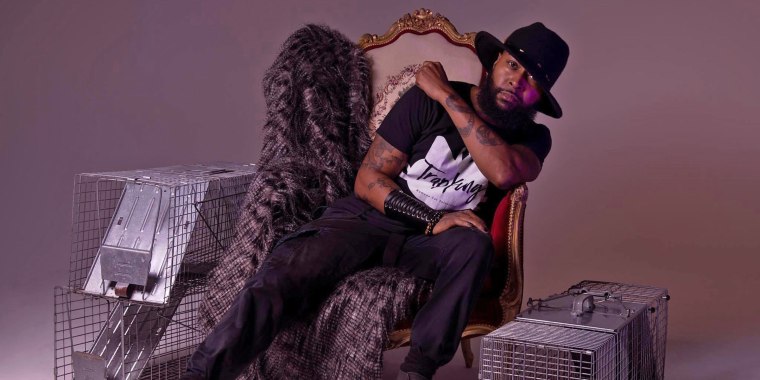
“I think something as selfless as rescue could be an example to the world of unity and working together,” said Sterling Davis, a.k.a. the TrapKing.

Sterling Davis, aka The Trap King.

Sterling Davis, aka The Trap King.Weir MediaNov. 29, 2020, by Jen Reeder

This story was originally published on Today.com.

Atlanta resident Sterling Davis was on a break from a rap tour when he applied for a job at the county shelter scooping kitty litter. He just wanted to stay busy and make a little money. Plus, he’s always loved animals, like his cat at the time, Rick James.

“I did horrible in the interview because they had cats in the room and I was playing with all the cats, kissing all the cats,” he told Today.

Even though he didn’t really answer any of the questions because he was distracted by the friendly felines, he got the job because, as the person who hired him said, “We’re not seeing people like you with cats.”

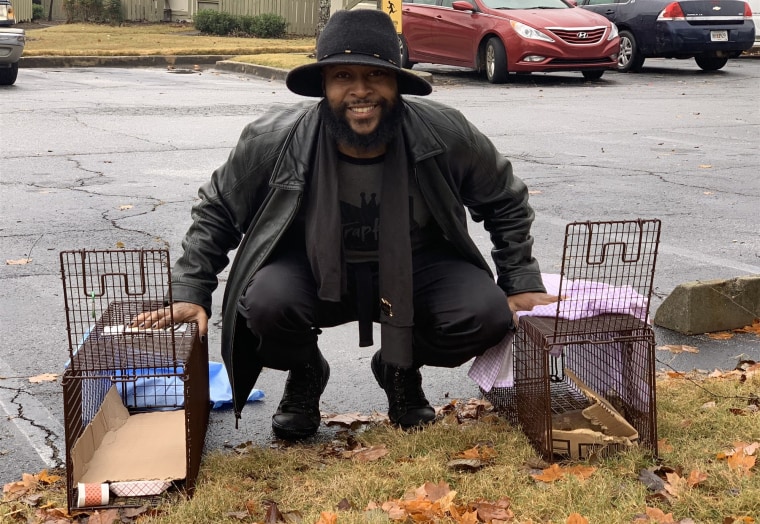
Davis, 40, started helping shelter employees with trap-neuter-return cases. The team would trap community cats (formerly called “feral”), bring them to the shelter to be vaccinated and spayed or neutered, and then return them to their outdoor realm.

While Davis learned about TNR, he came to another realization.

Sterling TrapKing Davis
Most community cats wouldn’t do well inside a home, so trap-neuter-return is the humane alternative to euthanasia. TNR also reduces feline overpopulation, curbs the spread of disease and helps with rodent control.Courtesy of Sterling TrapKing Davis

“At the county shelter, there were no men and no Black people that worked in the cat department,” he said. “When I would go out and do TNR with all my friends, it would be all women — that’s who trained me. I finally asked the difficult question: ‘Where are all the guys and where are all the Black people?’’

The answer: There’s just you.

Davis realized he had a new calling. He let his band know he would not be coming back on tour. Instead, he was going to devote all his time to cat rescue as the TrapKing.

After five years of working at the shelter run by LifeLine Animal Project and training with Best Friends Animal Society, Davis founded the nonprofit TrapKing Humane Cat Solutions in 2017.

His bold goal: to change stereotypes of men in cat rescue and bridge the communication gap between Black communities and predominately white animal welfare organizations.

“I’ve seen rescue be something that’s looked at as hard, tedious, sad,” he said. “If people can see me and I make this look like this is a rock-star type life, this is fun — you can do it.”

When his music money dried up, Davis sold everything he owned and bought a conversion van to live in to help pay for cat surgeries and support his nonprofit. He plastered the van with TrapKing logos and people started noticing. He hosted contests for kids, who would watch his humane traps. Whoever texted him first about a cat in a trap won $20, second place got $15 and so on.

Sterling TrapKing Davis
Sterling Davis has always loved cats. “They’re pretty amazing creatures,” he told TODAY. Courtesy of Sterling TrapKing Davis

“I started going into neighborhoods and kids would see me like the ice cream truck,” he said with a chuckle. “I would pull into apartment complexes and see young boys running up to the van trying to give me cats. ‘Hey Trap, look — I got a cat. Do I get some money?’”

As the TrapKing became better known, opportunities arose. The Atlanta Humane Society offered to spay and neuter cats he brought for free, which was a huge help since he wasn’t charging anyone for his services.

Davis, who enlisted in the Navy right out of high school and served for two years as an operations specialist manning the ship’s radar, said he believes his experiences have helped him connect with people from all walks of life as the TrapKing.

“I think being in the military, being around different people, different cultures and being in entertainment is what actually helped me better communicate with all types of people and better communicate this mission,” he said. “I’ve literally been pushing to make TNR community cat care as common as recycling and get more people engaged in so many fun ways.”

It hasn’t always been easy. Early on when Davis was returning cats to a predominately Black neighborhood, a group of men walked up and told him: “White people put tracking devices and diseases in these cats to hurt the Black community and you’re helping that. You’re bringing them into the neighborhood.”

“I was like, ‘Wow, that’s so wrong.’ It was really difficult to explain it because all the Black community could see was this is a white person’s thing,” he said.

Over time, perceptions have changed. When protests erupted across America in the wake of the killing of George Floyd, Davis launched a T-shirt campaign called “Allies in Rescue, Allies in Life.” He announced he would donate all of the funds to the nonprofit Campaign Zero, which promotes policy changes to end police violence. Support from rescue advocates and organizations was overwhelming.

“I got a lot of feedback from the Black community on that, like, ‘So you got all of these animal people to donate to issues other than just cats or dogs?’” he recalled. “I’m like, ‘Yeah — we’re allies in rescue and allies in life.’ So that really turned a lot of things around.”

A few months ago, Davis was setting a trap for a cat that surprised him by jumping into his arms. He adopted her and named her Alanis Mewissette.
A few months ago, Davis was setting a trap for a cat that surprised him by jumping into his arms. He adopted her and named her Alanis Mewissette. Courtesy of Sterling TrapKing Davis

Davis now runs TrapKing Humane Cat Solutions from an RV, which he shares with his cats Bowie, Damita Jo and Alanis Mewissette. He hopes to travel across the country soon promoting TNR and fundraising for animal shelters. He’s also pushing for the Boy Scouts and Girl Scouts to start offering a TNR badge.

Through it all, he’s continuing his outreach to communities and modeling his motto, “You don’t lose cool points for compassion.”

“I’ve had a lot of parents reach out to me and say that their son gets made fun of because he likes cats,” he said. “I just want it to be known that you cannot lose cool points for compassion. If you are doing something compassionate, you gain cool points.”

The TrapKing would love to see the rescue community find ways to put aside any differences and work together toward the common goal of saving the lives of pets.

“I think something as selfless as rescue could be an example to the world of unity and working together,” he said. “So I want to put that out there.”

Rescue in Crete

Sam Wilson is a volunteer at https://www.facebook.com/GeorgeShelterCrete/ She is a former police inspector with Nottinghamshire, England police. She served on the force for 30 years and retired in September 2020. A week later, she flew to Crete, Greece to volunteer with George Orfanidis and his George Stray Dogs organization. Sam’s plan was volunteer for four weeks, improve her Greek language skills, and then return home. The return-home part of her plan became complicated. Her time there inspired her to book three additional flights to Crete over the following two months, with more planned in the future. Sam now has a very long commute to work and works side by side with George.

George Stray Dogs was founded by George Orfanidis, who has devoted more than 20 years to rescuing and caring for dogs and bringing about positive change for animals by changing people’s minds and hearts through education. George houses 100 dogs at his shelters, which lack electricity and water supply. Every day, without fail, he drives the 70 km round trip bringing water and food to the dogs.

Animal welfare is not a priority in Greece. There are estimated to be 8 million stray dogs and cats in the country. They are routinely abandoned in the rubbish, in the mountains, and on the street. Some dogs are chained to barrels for the length of their lives, with little food and fresh water, and riddled with ticks, fleas, and worms.

George has been reliant on his fellow Greeks for donations for food for veterinary medicine, but Greece has been in recession for a long time. Many of the people who care about animal welfare have little money to give. The struggle for funding was somewhat alleviated when Australian animal activist Stella Savvas set up the organization’s Facebook page. George has also received various volunteer assistance from his brother Nikos Orfandis, and volunteers Katerina and Debra. The organization also received a boost when George’s friend, well-known Greek rescuer Takis Proestakis, mentioned him on his FB page.

The access to a wider audience has allowed George to build infrastructure at one of the shelters, which will allow all of the dogs to be housed at one site. Fencing, kennels, and easy access to water will make the rescue work easier. George, Sam, and other volunteers are currently working to complete the site work before winter sets in.

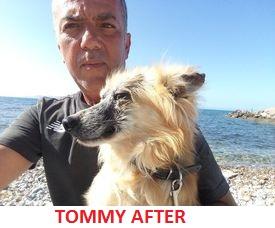
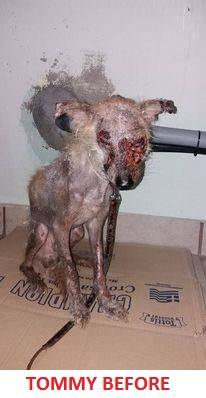
Some of George Stray Dogs rescue success stories – Before and After:

Tommy – George found Tommy in the filth of an abandoned house. The sight of Tommy reduced George to tears. Tommy had little fur and wounds all over his face and body from the effects of leishmaniasis, a parasitic disease which afflicts many dogs in the southern Mediterranean. After months of care, love, and treatment, Tommy was transformed into a beautiful dog. Tommy and George are now inseparable.

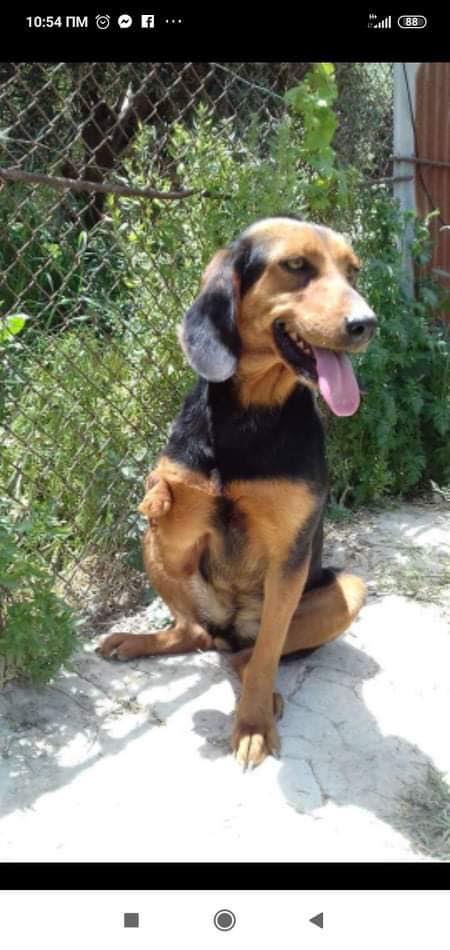
Hara – Hara was abandoned in the rubbish five years ago. George was caring for her as a stray on the streets. One day, he was alerted that some men had her on a chain and were ready to hang her. George went to the location and fought with the men to save her life. (He has been attacked more than one occasion for his work.) The men damaged George’s car and bruised him, but Hara was saved and she now lives at the shelter. Hara is a contented dog with a sweet and gentle nature.  The deformed leg with which she was born causes her no issues.

Dias – Dias is known as the Gentle Giant. He is a 60kg Greek Shepherd found on the highway with shattered legs, unable to move. With two surgeries and care from George he is thriving. The puppies particularly adore him. He’s the alpha dog in his pen but  calm and even natured with others.

The transformation of dogs from when they arrive at the shelter in heart-breaking condition to health, balance, and friendly dispositions. They form close bonds with each other and adore George. George has a huge heart, dedication, and deep compassion for the neglected, abused, abandoned, tortured animals on Crete, Greece.

If you would like to make a donation to George Stray Dogs, their Paypal account is

George Stray Dogs also have a Go Fund Me to raise money for a 4×4 car to provide consistently reliable transport to the shelter in winter.

Hara
Dias

For further information: https://www.facebook.com/GeorgeShelterCrete/

GSD

A Movie that Could Change People’s Ideas About Animals’ Ability to Think, Reason, Feel

Click Daily & Corporations Will Provide Food for Animal Shelters – Free To You

Animal rescue – corporate food donation

If interested, you can make this you home page, so that when you log onto the internet, you can click daily. It costs you nothing.

Here are instructions to do so, for various browsers:

Firefox

  • Open Firefox, then select the three, horizontal lines next to the profile icon.
  • Select Options, then select the Home icon.
  • Under New Windows and Tabs, select the dropdown next to Homepage and new windows.
  • Choose the option you prefer: Firefox Home (Default), Custom URLs, or Blank Page.

Safari

  • Open Safari, then choose Safari > Preferences, then select General.
  • In the Homepage field, enter a wepage address. To simply use the webpage you’re currently viewing, select Set to Current Page.
  • Choose when your homepage is shown.
    • Open new windows with your homepage: Select the New windows open with pop-up menu, then choose Homepage.
    • Open new tabs with your homepage: Select the New tabs open with pop-up menu, then choose Homepage.

Microsoft Edge

  • Here’s how to change your home page in the new Microsoft Edge :
    • Open Microsoft Edge, select Settings and more  > Settings .
    • Select Appearance.

    • Turn on Show home button.

    • You can either choose New tab page or select Enter URL for a page that you want to use as your home page.

  • Note: This topic is for the new Microsoft Edge . Get help for the legacy version of Microsoft Edge .

Internet Explorer 11

  • In the top corner of Internet Explorer, select Tools , and then select Internet options.
  • On the General tab, under Home page, enter the URL of the site you want to set as a homepage. You can add more than one URL. Or, to add the site you’re currently viewing, select Use current. If you add more than one URL, put each URL on its own line.
  • Select Apply, and then select OK


Petition to Ban (Incredibly Cruel & Dangerous) Wet Markets

Please consider signing this petition: click to view and sign

Threat to Public Health

Animal Equality has launched a worldwide campaign and petition calling for the immediate closure of wet markets across the globe. Wet markets get their name in part from the blood, guts, scales and water that soak the stalls’ floors, remnants from animals brutally killed for customers who desire to eat freshly killed meat.

In exclusive footage shot by Animal Equality at wet markets in China, Vietnam and India, animals such as deer, raccoons, crocodiles, and dogs are shown living in filthy conditions, suffering from dehydration, starvation and disease.

These markets are also a threat to public health and have been the source of documented disease outbreaks in the past, including SARS. Researchers also believe COVID-19 most likely originated from a wet market in Wuhan, China, notorious for trading in wild animals.

It is because of the public health crises wet markets cause, as well as the intense suffering inflicted on farmed animals, that Animal Equality is urging the United Nations to ban all wet markets. Not only do these markets pose an immediate danger to humans, but they are also intensely cruel and abhorrently inhumane to animals.

“I think we should shut down those things [wet markets] right away. It boggles my mind how when we have so many diseases that emanate out of that unusual human-animal interface, that we don’t just shut it down. I don’t know what else has to happen to get us to appreciate that.”
~Dr. Anthony Fauci, Director of the National Institute of Allergy and Infectious Diseases.
“If you take wild animals and you put them into a market with domestic animals or other animals, where there’s an opportunity for a virus to jump species, you are creating … a superhighway for viruses to go from the wild into people. We can’t do this anymore. We can’t tolerate this anymore. I want the wild animal markets closed.”
~Dr. Ian Lipkin, Infectious Disease Expert
“The animals have been transported over large distances and are crammed together into cages. They are stressed and immunosuppressed and excreting whatever pathogens they have in them. With people in large numbers in the market and in intimate contact with the body fluids of these animals, you have an ideal mixing bowl for [disease] emergence.”
~Prof Andrew Cunningham, The Zoological Society of London

Petition for Banning Animal Cruelty Videos on TikTok

Please consider signing this petition requesting TikTok to ban animal cruelty videos.

(Note: the photo in this post is a mild photo)

Please cut 6-pack rings before throwing them in the trash

The Associated Press reported that as many as one million seabirds and 100,000 marine mammals are killed every year by six-pack rings. Who knows how many land animals.

S. Korea is planning cruel dog experimentation – please sign petition ASAP!

LAST CHANCE: South Korea is funding cruel dog cloning experiments—in which most die or suffer severe pain—to engineer ‘designer’ sniffer dogs for airports. SIGN to urge South Korea to end this painful and unnecessary experiment before we hand in the petition NEXT WEEK: https://bit.ly/2VeBkrN

Image may contain: dog
Humane Society International
Charity Organization