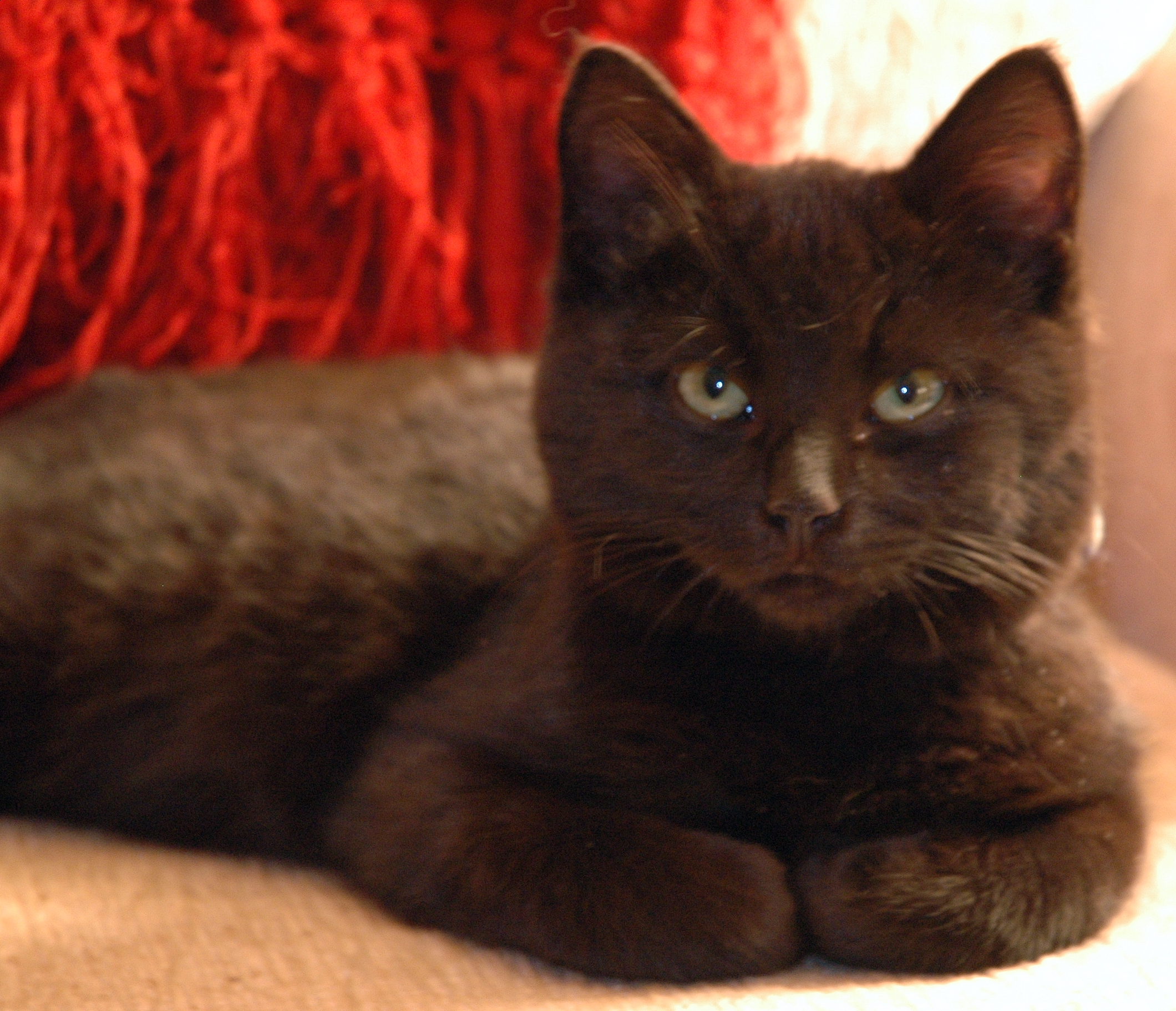
Four Winters, Four Summers, Four Days

Four winters.  That’s how long I was there. I remember each icy blast, each deep snow, and the mice far beneath, tucked into burrows I could not hope to reach.  I slept beneath the bramble and awakened with snow perched on branch and fur.

On the days when the creek’s ice cracked along the edges and snow melted in rivulets toward the pond, I knew I would not go hungry.

Four summers.  That’s how long I was there.  Other cats came and went from this place, and I fought often and hard for hunting rights, for the right to walk this piece of borrowed earth for a time.

You saw me one summer’s day, skirting along the edge of the forest.  I saw in your eyes compassion and distress at my gristly body.  You turned and disappeared inside, then returned with two small, circular objects, one with silvery water, the other with luscious scents.  You placed them at the garden’s edge and spoke softly to me:  “This is for you.”  I blinked slowly at you, acknowledging.

The scent of food brought back fragments of memory:  an old woman, a petting hand, a warm house.

I ate and drank my fill, then slipped off into the forest.  You watched.

Four days.  That’s how long you fed me.  On the fifth day, you placed a steel box on the ground with food and water inside.  I walked around it, wary, sniffing.  It smelled of other animals, and I sensed that you meant to trap me.  What I did not know then was that you would have taken me in and cared for me.

You dreamed about me that night—do you remember?  You stood on the back porch as I walked away, leaning into the wind.  I turned back toward you, my face round and scarred, my eyes telling you wordlessly: I will not return.  Did you remember every detail of the dream as you awoke, as if it were real?

Four days.  That’s how long you continued to set the trap with food and water.  On the fifth day you peered for a long time at the place where you had seen me in the dream.  Then you put away the trap and scattered the food in the forest for other animals to find.

He Wasn’t Much of a Hunter

He closes the door of the red pick-up truck, re-positions his gun over his shoulder, and sets off into the woods.  Despite trying to ease his weight onto the twigs and leaves, toe first then heel, his footfalls snap and crackle and echo through the pre-dawn forest.

A doe lifts her head from foraging, her button-black nose twitching with scent-taking.  With noiseless ease, she lopes off, her white tail high.  A groundhog stands on the crest of his mound-home squinting into the distance, his forepaws tucked up to his heart, his teddy-bear ears angled forward.  He squeaks and retreats inside his burrow.  A flock of quibbling sparrows wheels off into the sky.  Only the cat remains.   She is motionless except for the white tip of her tail.

The hunter walks on, pausing from time to time, looking around, then moving on.  The cat follows, unnoticed, at a distance.

When the sun has climbed well above the horizon, the hunter sits down on a large, sunny rock.  He opens a thermos of steaming coffee, crinkles flat the wax paper covering his sandwich, and munches thoughtfully, his head angled to the side.  Sun-warmed and drowsy, his shoulders relax and he closes his eyes.

The cats comes closer, soundlessly.  She sits a few feet in front of him and looks up.  The hunter opens his eyes and startles, then feels foolish.  He mutters something about cats—he’s never liked cats.  He glares at the cat and looks into her gold eyes.  She holds his gaze evenly.  He sighs, then he breaks off a small piece of cheese from his sandwich and tosses it on the ground.  The cat eats it and looks up expectantly.  The man breaks off a larger piece and holds it out to her.  She gracefully leaps onto the rock, and with one paw on the hunter’s leg, she gingerly takes the cheese from his hand.  The hunter slides his broad palm down her back, then offers her the rest of his sandwich.

After a while, he gathers his things, slings the gun over his shoulder, and sets off.  The cat jumps down and follows.  Twice he looks back over his shoulder.  He opens the truck door and sweeps his arm wide in a welcoming gesture. The cat jumps in, settles herself on the passenger seat, and washes her face.

Two seasons have passed since I found my hunter.  He wasn’t much of a hunter, really—I could read that much in the way he moved.  It was plain to me that he wasn’t really interested in hunting as much as he was playing a role.  It was also plain to me that he thought he didn’t like cats.  Most people who give cats a chance find they like them after all.

These days I wait by the window for my hunter.  He comes in with a blast of cold air.  I jump down and wind my way around his legs.  He stoops to pet me and says a word or two.  Then we pass a companionable evening in silence.  His gun is in the attic, tucked away forever.


• • • Have you ever rescued an animal?  Please tell us about it: Untoldanimalstories@gmail.com

Homeless Chihuahua Was Terrified Of Human Contact, But She Quickly Realized What She Was Missing

By Ashley Maisano – www.AnimalRescueSite.org

Hope For Paws received a call regarding a homeless Chihuahua who was alone on the streets and absolutely terrified.

Screen Shot 2018-01-27 at 11.22.12 PM

When rescuers arrived, they secured the area with fencing so the nervous Chihuahua wouldn’t be able to run away from them. One of the rescuers, Loreta Frankonyte, slowly went up to the dog to try and befriend her.

Screen Shot 2018-01-27 at 11.21.22 PM

She offered her some food, but she wouldn’t take it from her hand. She tossed it on the ground and she reluctantly gobbled it up. When she offered another piece of food, she finally took it from her hand.

She took a few more pieces, but when Loreta went to pet her, she snapped at her. She was still visibly afraid and didn’t understand yet that these people were there to help her.

Screen Shot 2018-01-27 at 11.21.22 PM


Eventually they slipped the snare around her neck and gently pulled her out. They thought it would be better if she didn’t feel cornered anymore. Once they got her out, they put the leash on and spent time with her to make her feel safe. They named this adorable pup ChiChi.

Screen Shot 2018-01-27 at 11.22.38 PM

She finally allowed them to pet her and began to trust them. They scanned her for a microchip, but unfortunately she didn’t have one. They brought her back to their clinic where they gave her a warm, much-needed bath to wash off all of the filth from living on the streets.

Screen Shot 2018-01-27 at 11.22.51 PM

She was still nervous at first, but after a while, her personality began to show. She was actually a very friendly and sweet dog. A week later, she went to live in a foster home with another one of Hope for Paws’ rescues named Washington. The two of them got along great and were the best of friends in no time.

Screen Shot 2018-01-27 at 11.24.04 PM

ChiChi is available for adoption. She is a very affectionate dog who loves to give kisses. She also gets along great with other dogs. If you’re interested in giving her a loving forever home, contact http://www.PawPrintsInTheSand.org.

ChiChi video

Restore Your Faith in Humanity in Four Minutes Flat


The Freckle on My Sister’s Snout

I am alone in my wanderings for a long time, but it hadn’t always been so.  I have vague memories–little scraps of images–from the past:  the tumble and tussle of warm fur, the shimmer of sun on my brother’s back, the freckle on my sister’s snout.  We grew up and dispersed, given away from a box in a grocery store parking lot to anyone who would take us.  We were held up and cooed over, and carried off under various people’s arms.

The person who took me changed his mind, tied me up in the back yard for months–with intermittent water and food–and then finally took me on a car ride and left me on the side of the road.  I’ve been fending for myself since then.  Sometimes I’m thirsty, sometimes I’m cold, often I am hungry.

This morning, a man saw me, stooped down and called to me.  I approached him warily and then darted away.  I have trouble trusting people.  I just spotted him again.  He is carrying a bowl that smells heavenly.

He sits quietly beside the bowl and I approach, then back away, then approach again.  With one last sideways glance at the man, I lean toward the bowl and begin to eat.  The man reaches out his hand and strokes my fur, first tentatively, then steadily.  His voice is kind.  When he slips a lead around my neck, he bends down to my level and says, “Come with me; we will find you a home” I go with him, to the first warmth and comfort I’ve known in a long time.

We Can Do More Than We Think We Can

What does it take of us to help an animal in need?  A bit of time, perhaps, and some inconvenience.  We’ve helped one animal to suffer less.  This small victory does not have a widespread impact, but it certainly changes the world for that one animal.DSC_0135 2

It’s easy to bypass an animal in distress, a lost dog, a stray cat, injured creature, a starving animal.  It’s easy to turn away and to assume that others will do something.  Most of us don’t do anything.  It requires giving of ourselves or our time in some small capacity, and we’re busy, busy, busy.  I believe that each time we turn away, some small portion of our humanity is eroded.

Years ago I made an agreement with myself: when I see an animal in need, I will do whatever I can to remedy the situation.  I’ve found that “whatever I can do” is generally more than I had originally thought.  This has led me to capture stray dogs and humanely trap stray cats and deliver them to the SPCA, to gently instruct children and others in kindness to animals, to intervene when I see human cruelty to animals, to become a vegetarian, to inconveniently arrive late at meetings when I’m rescuing an animal.  I sleep better at night for all this.

My dream is to have a widespread impact on humane treatment of animals.  If each of us engaged in some small gesture of kindness, of help toward animals, so much suffering could be reduced.  Will you join me?

raleigh

Armchair Animal Activism – part 3

You’re here to help animals. So are we.  Join the Humane Society of the US in their efforts.   http://www.humanesociety.org/  Click on any of the links below to make a difference.
  1. You make our work possible. Donate now to help animals who desperately need you.


    46 dogs rescued from cruelty and neglect in Arkansas this week. Animal lovers like you made this possible.

    Don’t be silenced. Speak out against dangerous “ag-gag” bills to help protect farm animals!

  2. Speak up for farm animals!

    Meet the love of your life through the Shelter Pet Project.

    You’re invited to a special screening of At the Fork, a new film taking an unbiased look at the lives of animals in our food system.

    Wayne Pacelle's The Humane Economy

    Are you an eBay user? Whether you’re shopping or selling, you can donate back to our lifesaving work for animals!

Drive change for animals!

ARMCHAIR ANIMAL ACTIVISM – Ask Sec. of State John Kerry in Intervene for Former Bomb-Sniffing Dogs in a US-Owned Facility

https://animalpetitions.org/132540/shut-down-security-company-that-allegedly-massacred-dogs/

Armchair Animal Activism (it works)- Part I

From the comfort of your living room, you can have an impact on humane treatment of animals.  This is part I in a series that provides ideas on how to do so.  Today’s topic is the hundreds of thousands of homeless, unspayed/unneutered dogs and cats in the South.

Several thousand rescue dogs are transported yearly from the South to the Northeast for adoption.  Why?  The cultural norm in many places of the South is not to spay and neuter, and in many places, not to inoculate pets against disease. There are millions of homeless dogs wandering around—and starving—in the South.  There are several thousands in high-kill shelters, because adoption is not a common practice either.

You can do something about it. Cultural norms are shifted over time through the steady application of change. For example, remember how we used to call humane organizations “pounds” and homeless pets “strays”? That gradual shift away from “pound” has had an impact on how people perceive humane organizations, and the introduction of the word “rescue” to adopted animals positions the rescuers to have the added benefit of feeling good about themselves.

But back to the Southern dogs. I was told by owner of Main Line Animal Rescue that the way to make an impact on treatment of dogs from the south is to write letters to the editors of the papers there. Below is a sample letter you can use or adjust as you see fit. Search this link ( http://www.50states.com/news/ ) to identify newspapers. Copy/tailor and email the letter to the editor—be sure to include your contact info, or the editors will not publish the letters.   Thank you!

your name
address
phone
email

date

Dear Editor,

I have a friend who had good fortune to adopt a sweet dog from Alabama via a Pennsylvania animal rescue. “Finn” is a hound mix and is doing well despite a rough beginning: unneutered, homeless, and unvaccinated, Finn contracted distemper, from which he has recovered, despite lingering gait issues.

I’ve learned that in areas, spaying/neutering, and vaccinating pets are not always common practice.  Yet pet overpopulation is rampant, and in many states hundreds of thousands of dogs and cats are homeless and die slowly from starvation, disease, and injury. You can help prevent pet overpopulation and suffering.

Please consider the benefits of spaying and neutering—this prevents unwanted animals from being born, improves the animals’ disposition, and is not perceived as loss by the animals.  Here is a link: http://www.aspca.org/pet-care/general-pet-care/low-cost-spayneuter-programs where you can find low-cost clinics in your area.  Alternatively, please consider asking your local vets to provide this community service, for the good of the animals and the community (and good PR for the vet).

Respectfully,

[your name]


10 Reasons to Adopt a Cat

Cats make up approximately 70% of shelter population. It’s sort of obvious what you should do…ADOPT! Don’t Shop! There are many advantages when it comes to adopting cats from shelters. Many are already spayed or neutered. They are also current on their shots. Shelter volunteers are there for one reason: the good of the animal. They aren’t interested in a profit and any donation you make goes right back into helping more animals in need. I love cats, how about you?

by Julie E.H., Animal Rescue Site blog
theanimalrescuesite.greatergood.com