Are you looking for a Christmas or holiday present for an animal lover? Since some backyard dogs don’t have appropriate “homes”/shelter, here’s a gift idea that animal lovers and dogs will appreciate. You can contribute, in the gift recipient’s honor, to a sturdy, insulated dog house that will be delivered to a backyard dog, providing warmth in the winter, protection from the elements, and shade in the summer.
The reasons why people tether their dogs 24/7 in all seasons vary—inherited family traditions normalizing it, lack of awareness of alternatives, landlord restrictions prohibiting indoor dogs, nonexistent or damaged fencing, and behavioral challenges/destructive indoor behavior. Sometimes, well-meaning people might not realize that these lonely backyard dogs can suffer. You can help via the links above or the ideas below.
Compassion in Action
• Build owner trust – Politely and by using friendly, non-accusatory language, offer help with supplies or walks. The owner is more likely to say yes to offers along the lines of: “I love dogs and have extra time/supplies, could I help with…?”
• Improve shelter and bedding – Add/upgrade a doghouse with walls, raised off the ground (wood pieces under four sides, reducing ground chill transfer), a door flap to block wind and rain, and straw for bedding and joint cushioning (not hay or cloth, which retain moisture and freeze).
• Ensure adequate water and food – Provide a tip-proof water bowl; donate quality food.
• Provide toys – Give the dog chew toys and balls to alleviate boredom.
• Watch for cruelty or neglect and report it – Document neglect (no water or shelter; skinny; an injury) and contact animal control or police department.
Ask anyone who lives with pets whether animals think and feel, and they’ll likely raise an eyebrow, privately wonder whether you’re nuts, and answer, of course they do. Over time, more and more researchers have come to agree.
Not long ago—by that I mean the late 20th century—the widely held belief was that animals were incapable of thought and emotion and only reacted mechanistically to stimuli. The foundations of this are traceable in part to 17th century philosopher René Descartes who posited that nonhuman animals were “automata”—complex biological machines devoid of reason, thought, consciousness, sentience, and feeling. Their cries, for example, were machine-like reflexes and pre-programmed responses to stimuli rather than indicative of pain or feeling.
Religion, moral convenience, and psychological and social factors have played a role in this thinking and have justified a comfortable status quo. Christianity, Judaism, and Islam religions believe that humans are uniquely made in the image of God. Only humans possess souls, so goes the thinking, and animals lack inner experience, rational thought, and the ability to feel genuine emotion and pain. There’s a psychological incentive to downgrade or deny animal cognition and sentience and to dismiss animal suffering as robotic reactions—it makes eating meat, animal experimentation, and the cruel practices of factory farming much less troublesome.
For years some scientists and philosophers contended that since animals couldn’t use language to report their inner experience, its existence couldn’t be scientifically validated and therefore should not be assumed. In the early and mid-20th century, strict behaviorists B.F. Skinner and John B. Watson led a movement that focused on observable behavior, treated references to animal consciousness, feelings, and thoughts as scientifically meaningless, and confined research to measurable stimuli and response. For decades the study of animal sentience and concern about the ethical treatment of animals lay more or less dormant.
Over the last several decades, evidence from the disciplines of ethology (animal behavior), animal cognition and comparative psychology, neuroscience and neurobiology, evolutionary biology and psychology, and cognitive science has made it harder to maintain the belief that animals do not think or feel. Researchers began designing experimental methods yielding strong and converging evidence that animals think (demonstrating flexible, goal-directed cognition) and feel (have conscious experiences such as fear, pain, and pleasure). Experiments with diverse mammals and nonmammals (including insects) have shown that various animals can solve problems, plan ahead, remember past events, recognize individuals and self, use tools, display grief, joy, jealousy, empathy, and fairness, and exhibit metacognition (knowing that you don’t know). Brain imaging and neurophysiology have shown a biological continuity between humans and animal brain structures and activity patterns linked to emotion, pain, and consciousness.
A number of scientific groups and conferences have issued statements on animal cognition and sentience. For example, the University of Cambridge Declaration of Consciousness (2012) states that nonhuman animals, including mammals, birds, and sea creatures, have the neurological substrates for consciousness. The New York University Declaration on Animal Consciousness (2024), signed by 500+ scientists, affirms strong support for conscious experience in mammals and birds, and a realistic probability in all vertebrates and in many invertebrates (cephalopods, crustaceans, insects), and urges welfare considerations.
Marc Bekoff, Professor Emeritus of Ecology and Evolutionary Biology, University of Colorado at Boulder, states in his book The Emotional Lives of Animals, “Human beings are a part of the animal kingdom, not apart from it. The separation of ‘us’ and ‘them’ creates a false picture and is responsible for much suffering.”
Intermittently I’ll be writing articles summarizing research findings and providing anecdotal stories about animal cognition and sentience. Stay tuned!
Do you have any personal stories about something an animal did that gave you a window into their thinking? If so, I’d love to hear it.
Compassion in Action:
The next time you are about to buy factory-farmed meat (which is what is sold in virtually every grocery store), consider what that animal likely endured and whether you feel comfortable supporting a large-scale industrial system that prioritizes efficiency and profit over animal welfare. For meat eaters, an alternative is to look for labels that say sustainably raised, locally raised on pasture-based farms, humanely raised, free-range, or Certified Humane, or contact a butcher who will likely know of local farmers who raise animals.
Gracie the cat found her way to us when my daughters were young. She had been thrown from a car and made her way to the yard of a kind couple who cared for her. Their inside cat was highly territorial and wouldn’t tolerate another cat, so they sought a home for this ginger-colored cat. Through a friend of a friend, she came to us.
When she entered our house, Gracie was respectful. She moved gently and quietly, her body and pace relaxed. She observed people and animals before doing anything. Our resident cat was unthreatened and curious about her. Our rescue pit bull befriended her, showing his affection by frequently slurping the side of her face. Gracie squinted against it, shook off the spit, and then gazed fondly at the dog.
Gracie connected deeply with my younger daughter in particular and allowed her to do the things that young girls sometimes do: dress the cat in doll’s clothing, push her around in a pram, and drape her over her shoulder and wander through the house.
Gracie seemed to have an understanding of emotional needs of her humans. One example is this: she had always slept with my younger daughter, but the one and only night she changed her routine was when our beloved pitbull died. That night, Gracie divided her time evenly between us, lending her gentle presence by snuggling against us in our beds before moving to the next person.
I love this peaceful photograph of her. Gracie sat for a long time gazing out at the twilight snowfall. When she turned, she looked at me, blinked slowly (the cat equivalent of a kiss), jumped down, and sauntered through the house.
Thanks for reading! Subscribe for free to receive new posts and support my work.
Roughly 6.5 million animals enter shelters in the US each year but only 3.2 million are adopted (ASPCA). Progress has been made: compared to 1973, the number of cats and dogs entering shelters annually is down more than 20 million (Humane World for Animals [formerly Humane Society of the United States]).
If you are in the market for a dog or cat, this site is searchable by location, species, gender, age, color, care and behavior, and whether they’re good with kids, dog, and cats: Find an adoptable cat or dog near you: https://www.petfinder.com/
Please take a look on Substack and subscribe for free for a weekly dose of hope with real stories, insights, and simple actions you can take to improve animal welfare.
I’m Carolyn Cott, an animal-welfare advocate and professional writer who’s always asking, “How can we make things better for the creatures who share our world?” Perhaps you’re asking the same question.
Whether you’re a seasoned rescuer, a caring pet parent, or someone who simply wonders, “What can I do to help?” this space is for you. Here’s what you’ll find:
Heartfelt, real-life stories of animals (and humans) that uplift and surprise
Research and insights into animal behavior, antics, and communication
Myths versus facts about animals, animal advocacy strategies that work, and human-animal connection
Interviews with vets, rescue workers, trainers, and public officials
Practical ideas—mini-actions and meaningful moves—that you can easily act on
I know that a lot of writing about animal welfare can feel heavy or alarming. Here we shift the tone to hope and curiosity rather than fear, to connection over detachment, and to actions—big and small—that are doable and feel meaningful.
I’d love to hear from you: your thoughts, your questions, even weird things your dog or cat does (my ears will perk up), and topics you’d like to see featured.
Here’s to kindness in action, discovery in every paw print, and shared steps toward a gentler world. Please subscribe for a weekly letter delivered to your inbox and please share this post. Thank you!
Looking at online listings for adoptable pets can be fun, but when you’re ready to decide on a dog or cat to bring home, it’s time to choose an animal shelter to visit. You may be surprised by which animal in your local shelter captures your heart and feels like the perfect fit for your home and life. Taking the time to interact with a potential pet in person can help you find the right pet for you, as well as give you the opportunity to ask questions of shelter volunteers.
When you feel prepared for your visit to an animal shelter, you can ease any anxiety you may have about shelter pet adoption and make sure that you’re ready for the commitment of pet parenthood.
Before visiting the animal shelter
While you can walk into an animal shelter any day they’re open, it helps if you can prepare yourself for the task of choosing a pet to adopt. Spend some time browsing online listings for your local shelter but don’t set your heart on a specific pet before you meet them. You may fall in love with a completely different animal at the shelter, so keep an open mind — and heart.
Consider what type of pet is the best fit
Before you visit a shelter, think about what you want in a pet.
Does your schedule allow for the needs of a dog, or is a cat a better fit?
Do you have the time to train a young dog or is an older dog more suited as a pet who already knows the basics?
Shelter volunteers can help you find the right pet for you. They know a lot about the animal’s personalities and temperaments and can answer your questions to pair you with the right animal for your family and household.
Do some research
Read up on the animal shelter online and learn what to expect from their adoption process. Every shelter and rescue has their own steps to adopting a pet, so make sure you understand required fees and the information you’ll need to fill out an adoption application. Some shelters may require a home visit to make sure your environment is suitable for your chosen pet, while others may only require you to fill out a form and provide references.
Gather your supplies
While you likely won’t bring home a new pet after your dog shelter visit, it’s still a good idea to have your home prepped for their arrival. Make sure to pet-proof your house or apartment, putting away any cherished personal belongings to avoid damage. Go on a shopping trip to purchase all the supplies you’ll need for your new family member, such as food and water bowls, a collar and leash, toys, and treats.
Choose a time to visit
Many animal shelters are fine with walk-ins during their posted hours, but if you want to make sure a volunteer is available to speak with you, it doesn’t hurt to call and schedule an appointment. Find a time that works for you and anyone else you plan to bring along, whether that includes other members of your family or a friend for moral support. If you’re not able to visit the shelter in person, ask if there are virtual animal shelter visits available.
Bring your entire family
A visit to the animal shelter should be a family affair. Bring along everyone who will share in the responsibility of caring for the new pet, so you can make sure the animal is the right fit for everyone involved.
Taking children along when you visit an animal shelter can be a challenge, so it’s important to establish rules for their behavior before you go. Bringing your kids along can help them feel involved in the decision and get them excited about caring for a new pet.
During your visit to the animal shelter
Keep in mind that shelter staff and volunteers are often busy, and you may have to wait before you can spend time with a potential pet. Prepare for the animal shelter visit experience to be a noisy one, with excited shelter dogs barking about new people in their space.
1. Be patient and understanding
Animals may act differently in a shelter environment than they would in a home. Be patient and understand that a rescue dog or cat could be overwhelmed by new people, especially if you bring children with you. Give the animal space to approach you on their own terms, and remind children to pet them gently.
2. Ask questions
Don’t hesitate to ask shelter staff questions about your potential new pet, such as how the animal shelter cares for their animals and what training the pet may have had. This is your opportunity to learn about an animal’s health history, any behavioral issues, and how well they do with other animals. You can also ask about the next steps in the adoption process.
3. Take your time
As exciting as it is to visit a shelter and look for a new pet, don’t be disappointed if you don’t find the right dog or cat immediately. Your goal should be to connect with an animal who fits with your lifestyle. Be sure to take your time and be open to any animal in the shelter being the right one for you.
Tips for visiting an animal shelter
When you’re looking for a dog or cat to adopt, seeing all the animals in a shelter can be overwhelming. Keep these tips in mind as you visit your local shelter.
Spend time with the animals to get a clearer idea of what pet is best for you.
Keep an open mind and give every animal the chance to steal your heart.
Consider pets who are less likely to be adopted, such as senior animals.
Stay safe and pay close attention to any posted signs or notices.
Commonly asked questions
How can I ensure a successful shelter visit when looking to adopt a pet?
The best way to ensure a successful shelter visit is to be patient with both staff and animals, and take your time when choosing a new pet to adopt. Don’t hesitate to ask questions of shelter staff, whether about the animals or the adoption process — or both.
Can I donate to the shelter during my visit?
Yes, you can donate to the shelter during your visit. Shelters are always in need of supplies and financial support to help care for their animals. The staff will likely be more than happy to accept a donation during your visit.
The following local organizations are working around the clock to support displaced and lost pets. Visit their websites and social pages to find their latest requests and learn how to best help them, because some are at or reaching capacity for donations. Much of this list comes from World Animal Protection, which has more information here.
Pasadena Humane has taken in hundreds of animals affected by the Eaton fire. Due to overwhelming support they have no more capacity for material donations or fosters, and have put a pause on volunteer applications, but are in need of monetary donations.
Pet owners in need of supplies can come pick up items at Pasadena City College, Lot 4, Level 1.
Los Angeles Animal Services has issued an urgent plea for fosters and adopters to take pets from their crowded shelters. This will open space in their six shelters for displaced animals and pets. You can sign up to foster or adopt for free — the adoption fee has been waived.
LA Animal Services is also accepting monetary donations.
Best Friends has an emergency response team on the ground assisting other animal welfare organizations.
They have opened two pet pantries in Sawtelle and Granada Hills where people can pick up pet supplies.
They have requested donations of large airline crates to help transport dogs to their shelter in Utah. They also have a wishlist on their website with needed items that you can order and send to them.
All of us can make a difference for animals in our everyday lives, whether it’s by adopting a pet, choosing products not tested on animals, eating a humane diet or engaging your community in animal protection issues. With so many widespread problems facing animals, it takes all of our collective efforts to confront these cruelties and change things for the better.
Here are 50 ideas for ways you can help animals in your community and across the country. Please share this list with any of your friends and family members who are also interested in advocating for animal protection.
14. Join us in applauding pet stores that have taken a stand against puppy mills—support the more than 1,000 stores that have joined our Puppy-Friendly Pet Stores initiative. Encourage local stores that do sell puppies to stop.
27. Shop our Amazon storefront for branded apparel that lets you wear your support on your sleeve.
28. Purchase pet health insurance from Petplan and receive a 5% discount—and with each completed application, Petplan will make a $20 donation to our Humane Society Veterinary Medical Alliance’s Rural Area Veterinary Services program. Use code HSUS20.
By providing your mobile number, you agree to receive autodialed, recurring text messages from the HSUS with updates and ways you can help animals. Message and data rates may apply. Text STOP to 77879 to opt out, HELP for info. Privacy policy.Terms and conditions.
The Humane Society of the United States is registered as a 501(c)(3) nonprofit organization. Contributions to the HSUS are tax-deductible to the extent permitted by law. The HSUS’s tax identification number is 53-0225390.
Everyone knows that cats meow, dogs bark, and cows moo. But you don’t need Old MacDonald to tell you that animal communication is infinitely more complex than that. In fact, if you do a dive deep on how, exactly, some creatures talk to each other, you’ll find secret languages that make the disparate languages of humanity—of which there are 6,900, according to the Linguistic Society of America—seem rudimentary by comparison.
1 White Rhinos Speak via Dung
White rhinos, who have terrible eyesight, use communal dung heaps (called “middens”) as a something of a community bulletin board where they can leave messages—that one rhino is sick or another is ready to mate, if a dominant male has recently wandered through—to the rest of the group.
2 Mantis Shrimp Flash Lights
This creature has some of the most impressively complex eyesight in the animal kingdom, with 16 color receptors (compared to our measly three), which come in very handy when trying to communicate with one another. They use their own bodies to communicate using polarized light that other animals cannot spot. Researchers have found that they bounce light off bleu spots on their appendages called maxillipeds, scattering and arranging light across the surface in ways that can covey information to other mantis shrimp—rather than merely reflecting it.
3 Sperm Whales Click
This species of whale uses clicking sounds known as “codas” to convey information to one another. Those in different areas of the ocean use different clicking patterns, sort of like regional dialects—so Caribbean sperm whales sound slightly different than those in another part of the ocean. Researchers have been particularly interested in a group near the Caribbean island of Dominica, which they’ve found may even have variations between different clans or individual whales.
4 Caterpillars Send Out Decoy Distress Calls to Ants
The caterpillar of the alcon blue butterfly scrapes its abdomen to create a kind of song. But unlike many other such critters, who use their communication techniques to contact others of their species, this is a message meant for a very different creature: red ants. The song imitates that of the red ant queen, so those soldier ants that hear it will guard the caterpillar, even killing their own kind in order to protect it.
5 African Elephants Vibrate to Each Other
Technically, elephants make very low sounds to one another. Thing is, they’re so low that it does not strike the human ear as a sound—or anything more than a rumbling vibration. Known as “infrasound” (sounds below 20 hertz, too low for humans to detect), this way of communicating may seem quiet to humans, but researchers estimate that one African elephant making an infrasound can be heard by another more than 175 miles away!
6 Tarsiers Screech
These tiny, big-eyed primates living in Southeast Asia communicate at the opposite range of elephants—ultrasound frequencies over 20,000 Hertz that are far too high-pitched for the human ear to detect. Scientists recorded them using similar devices as those used to record bats, capturing their vocalizations at 70,000 Hertz, which is believed to help them communicate over the jungle noise (and out of range of predators), making it ideal for avoiding or alerting one another of danger. By the way, tarsiers are one of the smallest animals in the world.
7 Ravens Have Sign Language
Shutterstock/Marcin Perkowski
Just as humans use their hands to emphasize a point, ravens do their own kind of gesticulating, using their beaks and wings to show or offer items such as moss, stones or twigs (usually aimed at members of the opposite sex). They also interact by clasping their bills together or moving an item together, as a show of potential bonding.
8 Egyptian Fruit Bats Argue
You’re probably aware that bats use high-pitched squeals to connect and communicate with each other. But you probably didn’t know how specific such communications could get. Researchers at Tel Aviv University used a machine-learning algorithm to recognize bats’ intonations and the messages they may be trying to convey, “translating” 15,000 calls into several specific messages—more than 60 percent were arguments about four specific things: food, sleep positions, invasion of personal space, or unwanted advances.
9 Chimpanzees Scratch Each Other
Chimps love to groom and to be groomed. But just like your spouse or partner loves a backrub…but even more if you focus on that one spot right there, chimps can be particular about where they want to get scratched, using “referential gesturing” to draw the attention of another chimp to the specific area they’d like to have groomed.
10 Geckos “Seamless” Their Food
Day geckos, native to Madagascar, pioneered the idea of instant-order takeout long before Seamless (or even humans) came along. But rather than an app on their phones, they simply nod their heads at treehoppers—insects that digest sap an excrete it in a sugary liquid known as honeydew. When the gecko communicates to the treehoppers that it would like some of that honeydew, the insects oblige, excreting it right into the amphibian’s mouth.
11 Electric Fish Discharge Electricity
You’re probably familiar with electrically charged sea creatures such as the electric eel, but there is a particular species of electric fish that is able to use its voltage as a means of communicating. Known as “weakly electric fish,” these creatures, which, as their name implies, produce a mild electric discharge, use it to “chirp” out information, such as a male stating it’s attracted a female. When two of these fish meet, they are known to tweak their wavelengths in order to allow each other to produce similar levels of voltage.
12 African Demon Mole Rats Head-Bang
“African Demon Mole Rat” sounds like a pretty good name for a metal band. As it turns out, these critters communicate through a kind of head-banging. Spending their lives underground, they can communicate with one another by thumping their heads against the tops of their tunnels, in that way sending vibrations through the earth that travel much farther attempting to make a loud noise would be able to. The pace and intensity of the thumps indicate different meanings. Rock on.
13 Black-Footed Titis Squeak
When black-footed titis (a brown, rainforest-dwelling monkey), use high-pitched squeaks to let each other known not only what types of predator may be near but their general location. Researchers have found that the monkeys vary their calls in a number of ways, creating their own syntax and complex communication system.
14 Gorillas Hum
Sometimes, singing to oneself is a way to tell the world you are away in your own world and don’t really want to be bothered by all the craziness happening elsewhere (hence, singing in the shower). That’s true of silverback gorillas too, which researchers have found will hum or sing while chomping down on their favorite vegetation. It’s not just a way to indicate that they are enjoying their meal, but a way to convey that they would prefer not to be bothered while eating. When they go quiet, that’s a sign that they are willing to chat.
15 Dholes Whistle
Dholes, otherwise known as Asiatic wild dogs, are also sometimes called “whistling dogs“—and with good reason. These fox-like animals alert each other about the location of prey through whistle sounds. This allows them to make coordinated attacks on other animals much larger than them, communicating in packs to take down prey that’s more than 10 times their own body weight.
16 Prairie Dogs Call to Each Other
These creatures are known for their complex underground tunnel systems, but they also have complex ways of calling to one another, using slightly different intonations (reportedly of a “chee”-like sound) depending on the type of predator—coyote, hawk, human—nearby. In one study, they were found to seemingly identify the difference between a person wearing a blue shirt and one wearing a yellow shirt.
17 Tap-Dancing Blue-Capped Cordon Bleu
As if its name isn’t cool enough, the blue-capped cordon bleu also has some killer dance moves, using a kind of winged tap dance to attract a mate. Both male and female birds of this species court by holding a piece of nesting material in their beak, and then bob up and down while they sing, and make super-fast dance steps with their feet. Researchers believe the dance is meant to not only catch the attention of a mate, but to demonstrate health and fitness.
18 Bison Choose Leaders With Their Feet
European bison are large creatures, but they speak softly, letting their feet do the talking. When the herds of these impressive creatures seek to move on, they decide which way to go not through the guidance of a single leader, but a complex process in which one of the members of the herd (it can be anyone, male or female, young or old) would walk 20 or more steps in a particular direction without stopping to graze. If the others trust the decision, they take the cue and follow along—and that leading animal becomes the herd’s de facto leader (until the process restarts). Perhaps we could take a cue from the bison…
19 Apes Stomp, Clap, and Shake Heads
There are many, many other cool ways that great apes communicate with each other; researchers have isolated some 80 gestures at least. But what may be most interesting is that these significantly overlap with human toddlers; as Smithsonian puts it, “researchers found the human toddlers used 52 discrete gestures to communicate, including clapping, hugging, stomping, raising their arms and shaking their heads, often stringing the moves together to convey complex ideas. It turns out that the chimps also used 46 of the same gestures, meaning there’s a 90 percent overlap.”
20 Caribbean Reef Squid Changes Color
Using specialized cells containing pigments and light-reflecting molecules known as chromataphores, the Caribbean reef squid can change the color of their skin to convey a variety of messages: to court a potential mate, to warn others of a predator or a number of other messages—even conveying one message to a squid on their left side and a different one to a squid on their right.
21 Dancing Bees, Well, Dance
Research going back centuries has noted that bees use dance moves to alert fellow hive-dwellers of a honey source. A famous study found that, when a bee discovered a honey source, it would head to the hive, performing a dance while other bees touched its abdomen, allowing the others to then find the honey source without needing to be shown. The direction and speed of the dance indicated specific geolocation details that the others could follow.
22 Jackdaws Glare
Just as humans can stare people down with their eyes in order to express their anger or frustration, so too can jackdaws, a bird that’s part of the same family as crows, ravens, and jays. Researchers have found that one of these birds will use his conspicuous eyes to glare at a would-be competitor, deterring it from trying to take over his nest.
23 Coral Groupers Team Up For Hunts
When these predatory fish are outsmarted by prey that dives deep into the cracks of the coral reefs, it get some help from other predatory species: usually either the napoleon wrasse or moray eel. The grouper will point with its nose to the location of the fish, shaking its body, and the wrasse will smash against the coral to open it up or the eel will creep into the cracks itself. Thanks to this team work, at least one of the predators, if not both, usually end up with dinner.
24 Chimpanzee Footsie
You could spend a lifetime analyzing chimps’ gestures. There are so many, in fact, that you can review an entire Great Ape Dictionary. Chimps have striking similarities with humans, and one of the other ways that researchers have found they signal to one another is through extending their feet to alert another (usually young) chimp to climb on them to travel.
25 Warbling Antbirds Sing Off-Time
Female Peruvian warbling antbirds will not tolerate other females making moves on their male mate and convey that message clearly to any would-be competitor who invades their territory. The mates generally sing together in a kind of charming harmony, but at the sight of an interloper, the female will shift to an arrhythmic singing that messes up the sound and creates an unpleasant cacophony, ensuring the other woman is not allured by the usual pleasant singing that might otherwise attract her. And for more on all things animal, check out these 50 Amazing Animal Facts
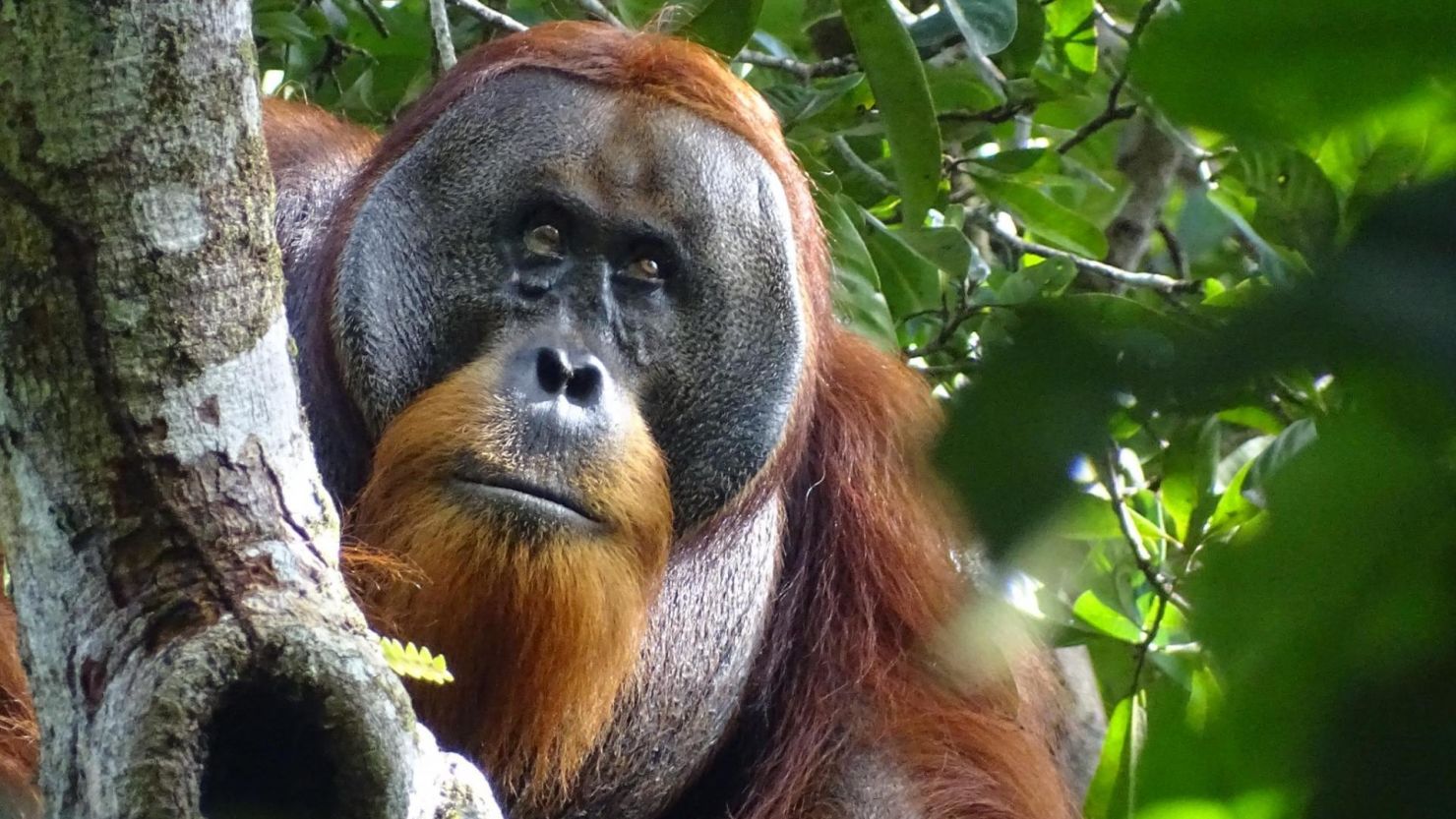
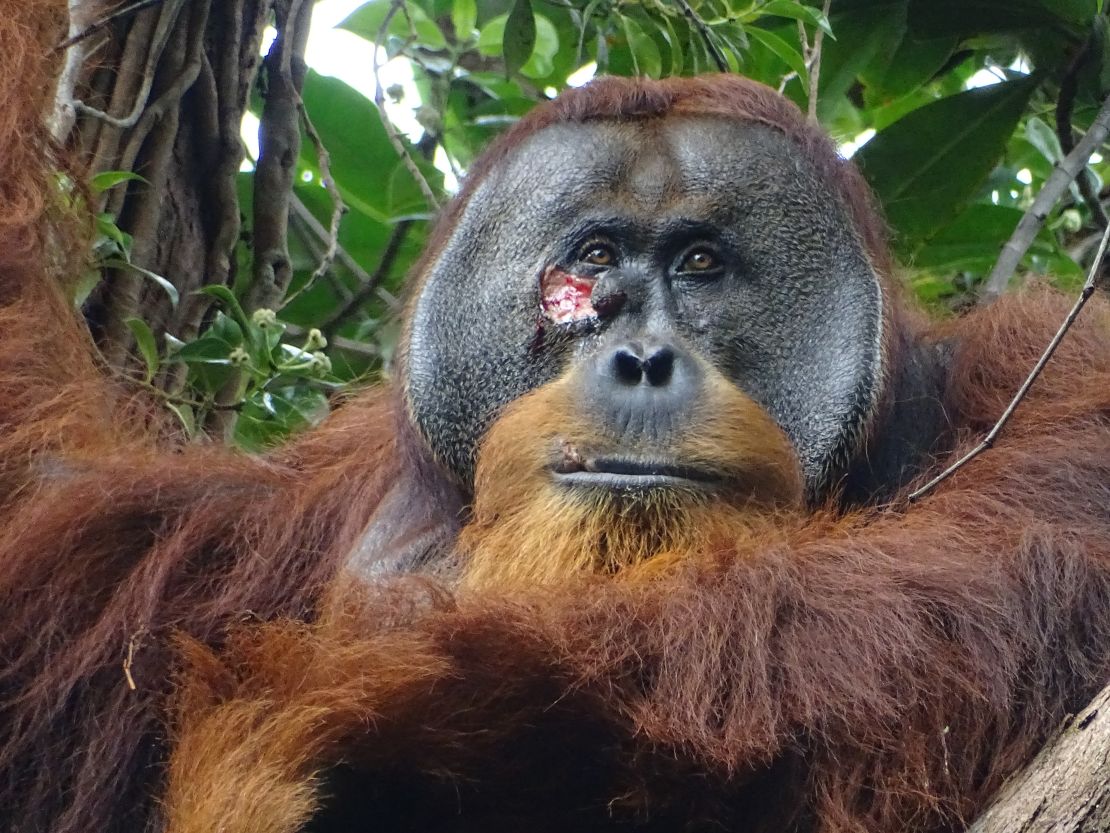
The male Sumatran orangutan treated a facial wound by chewing leaves from a climbing plant and repeatedly applying the juice to it.Armas CNN —
Scientists working in Indonesia have observed an orangutan intentionally treating a wound on their face with a medicinal plant, the first time this behavior has been documented.
Rakus, a male Sumatran orangutan, treated a wound on his face by chewing leaves from a climbing plant named Akar Kuning and repeatedly applying the juice to it, according to a paper published in the journal Scientific Reports on Thursday.
Rakus then covered the wound with the chewed up leaves, which are used in traditional medicine to treat illnesses like dysentery, diabetes and malaria, said scientists.
ADVERTISING
Study lead author Isabelle Laumer, a post-doctoral researcher at the Max Planck Institute of Animal Behavior, told CNN that the team were “very excited” by their observations, which took place in June 2022 in the Suaq Balimbing research area in Gunung Leuser National Park, Indonesia.
Although other wild primate species are known to swallow, chew or rub themselves with plants that have medicinal properties, scientists have never seen them used to treat recent wounds.
Rakus treated his wound in a process that took several minutes, researchers said.Armas
The team believe that Rakus intentionally used the plant to treat his wound as he applied it repeatedly in a process that researchers say took several minutes.
“This possibly innovative behavior presents the first report of active wound management with a biological active plant in a great ape species,” she said.
Researchers believe that Rakus most likely sustained the wound in a fight with another male orangutan, which are rare in the area thanks to “high food availability, high social tolerance between orangutans and relatively stable social hierarchies,” Laumer explained.
This means that orangutans rarely suffer wounds, giving researchers few opportunities to observe this behavior.
As for how Rakus would have learned how to treat a wound, one possibility is “accidental individual innovation,” said Laumer.
The orangutan may have touched his wound accidentally while feeding on the plant and felt immediate pain relief due to its analgesic – pain relieving – effects, making him repeat the behavior, she explained.
Another possible explanation is that Rakus learned how to treat a wound from other orangutans in the area where he was born, said Laumer.
The observation “provides new insights into the existence of self-medication in our closest relatives and in the evolutionary origins of wound medication more broadly,” added Laumer, raising the possibility that wound treatment may originate in a common ancestor shared by humans and orangutans.
Researchers plan to closely observe any other wounded orangutans in the area to see if the behavior is repeated, said Laumer, who added that the findings underline the commonalities between humans and orangutans.
“We are more similar than different,” she said. “We hope this study raises awareness on their critically endangered status in the wild.”
(From Humane Society of the United States) You’re driving your car when you see a dog or cat on the side of the road. With a sinking feeling, you realize they are alone. What should you do?
This is a wrenching scenario for all who care about animals. After all, what if your own pet were standing there? Use our guidelines for providing safe and effective help.
Don’t cause an accident
You can’t help an animal if you become injured in the process. Look in your rear-view mirror before braking, turn on your signal, pull your car completely off the road, turn off the ignition, set the parking brake, and put on the hazard lights. If you have emergency flares, prepare to use them.
Catch them safely
Safety first
A strange, frightened, and possibly sick or injured animal can behave unpredictably. A sudden move on your part, even opening your car door, can spook them and cause them to bolt—possibly right onto the highway. If the animal looks or acts threatening, or if you feel uneasy about the situation, stay in your car.
If possible, restrain the animal. Create a barrier or use a carrier, leash, piece of cloth, or length of rope to keep the animal in the area. Signal approaching vehicles to slow down if you cannot confine the animal, or divert traffic around them if they appear to be injured and is still on the roadway.
Use caution
Use caution when approaching the animal. Should you succeed in getting close enough to capture them, you stand a good chance of being scratched or bitten.
When moving toward the animal, speak calmly to reassure them. Make sure they can see you at all times as you approach, and perhaps entice them to come to you by offering a strong-smelling food such as canned tuna or dried liver.
Lure them into your car
If you are certain you can get help from animal control very soon, try to lure the animal into your car with food, close the door and wait for help. In most cases it isn’t a good idea to attempt to drive somewhere with a strange dog unrestrained in your car; they may become frantic or aggressive. Cats may do the same, as well as lodge themselves under the car seat, and it can be dangerous trying to extract them.
Call for backup
If you’re not able to safely restrain the animal, call the local animal control agency (in rural areas, call the police). Do so whether or not the animal is injured, and whether or not they are wearing an identification tag. Leave your phone number with the dispatcher, and try to get an estimate of how long it may take someone to respond. If possible, stay on the scene to keep an eye on the dog or cat until help arrives. Make sure you report to authorities precisely where the animal is by using road names, mile markers or landmarks.











 Untold Animal Stories