Thanks for reading! For weekly stories and simple actions that improve animal welfare:The Kind Life
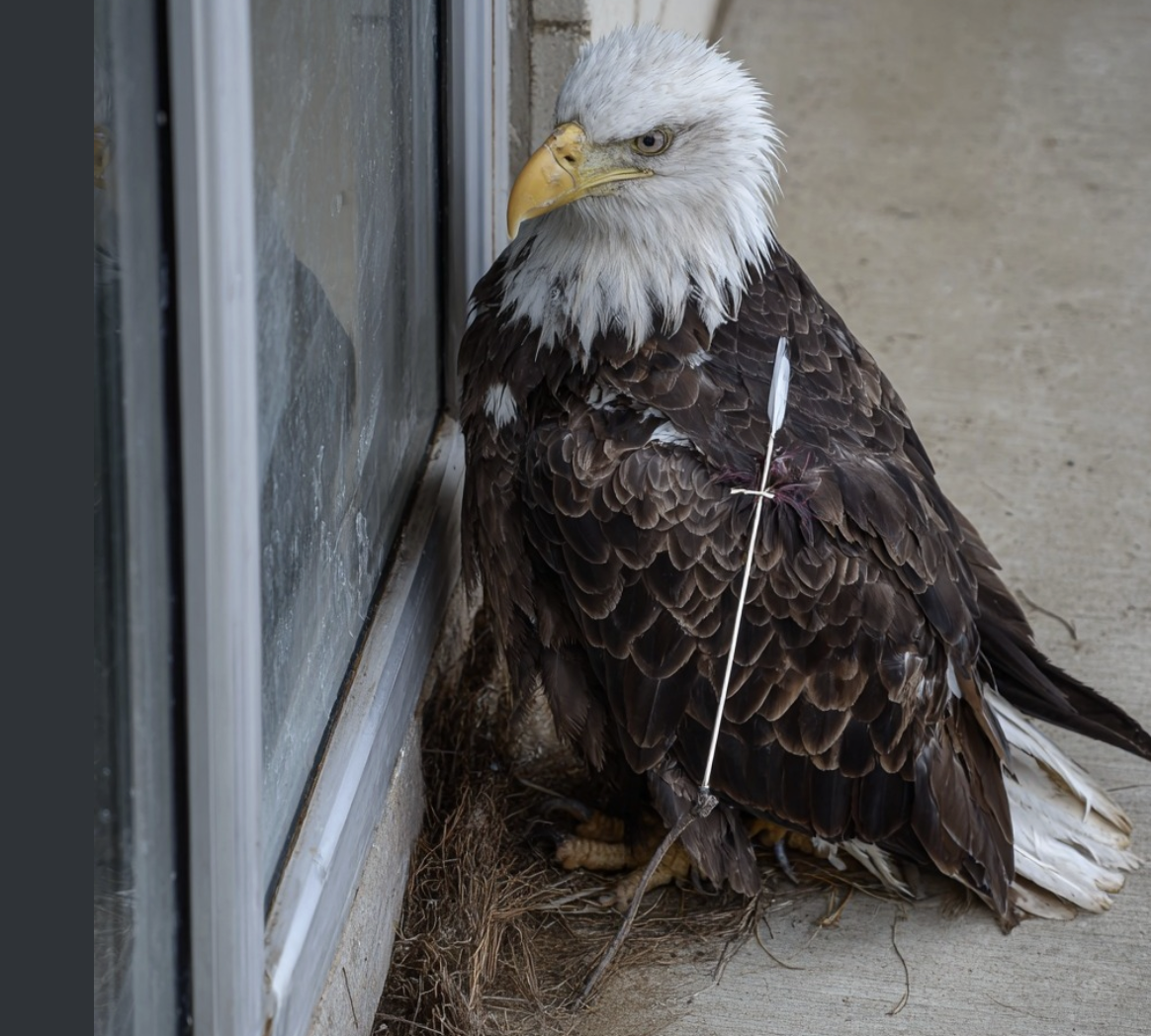
An injured, fully grown bald eagle was found at the door of wildlife rehab center in British Columbia. It remained unmoving and quiet, and peered into the glass door. A broadhead hunting arrow was embedded in its back and blood loss was evident.
When staff carefully approached, the eagle did not attempt to flee and allowed them to bring it into the facility. According to the veterinarians who treated it, the eagle showed no aggression or panic. Surgery was performed the same day and the wound was reported as severe but treatable. Without intervention the eagle would not have survived. The eagle was given antibiotics, pain management, and rehab to regain flight strength.
The eagle’s point of origin, route, and distance traveled are unknown, but one might surmise that the injury occurred in one of the hunting areas, none of which are close by.
Injured animals tend to seek cover instinctively, and there were several structures, unoccupied buildings, and forest edges where the bird might have sought cover. While biologists urge caution in interpreting events like these, the eagle’s behavior struck the staff as unusual. One stated, “It felt like it knew exactly where to go.” Even experienced wildlife professionals admitted the case was extraordinary.
Compassion in Action
What can you do when you see injured wildlife? Observe from a distance without approaching to avoid stressing the animal further, which could worsen injuries or lead to defensive behavior. Note key details like location, species, behavior, and visible injuries (e.g., limping or bleeding) for rescuers. Contact your local rehab facility by searching here: Local Wildlife Rehabs
The following local organizations are working around the clock to support displaced and lost pets. Visit their websites and social pages to find their latest requests and learn how to best help them, because some are at or reaching capacity for donations. Much of this list comes from World Animal Protection, which has more information here.
Pasadena Humane has taken in hundreds of animals affected by the Eaton fire. Due to overwhelming support they have no more capacity for material donations or fosters, and have put a pause on volunteer applications, but are in need of monetary donations.
Pet owners in need of supplies can come pick up items at Pasadena City College, Lot 4, Level 1.
Los Angeles Animal Services has issued an urgent plea for fosters and adopters to take pets from their crowded shelters. This will open space in their six shelters for displaced animals and pets. You can sign up to foster or adopt for free — the adoption fee has been waived.
LA Animal Services is also accepting monetary donations.
Best Friends has an emergency response team on the ground assisting other animal welfare organizations.
They have opened two pet pantries in Sawtelle and Granada Hills where people can pick up pet supplies.
They have requested donations of large airline crates to help transport dogs to their shelter in Utah. They also have a wishlist on their website with needed items that you can order and send to them.
Everyone knows that cats meow, dogs bark, and cows moo. But you don’t need Old MacDonald to tell you that animal communication is infinitely more complex than that. In fact, if you do a dive deep on how, exactly, some creatures talk to each other, you’ll find secret languages that make the disparate languages of humanity—of which there are 6,900, according to the Linguistic Society of America—seem rudimentary by comparison.
1 White Rhinos Speak via Dung
White rhinos, who have terrible eyesight, use communal dung heaps (called “middens”) as a something of a community bulletin board where they can leave messages—that one rhino is sick or another is ready to mate, if a dominant male has recently wandered through—to the rest of the group.
2 Mantis Shrimp Flash Lights
This creature has some of the most impressively complex eyesight in the animal kingdom, with 16 color receptors (compared to our measly three), which come in very handy when trying to communicate with one another. They use their own bodies to communicate using polarized light that other animals cannot spot. Researchers have found that they bounce light off bleu spots on their appendages called maxillipeds, scattering and arranging light across the surface in ways that can covey information to other mantis shrimp—rather than merely reflecting it.
3 Sperm Whales Click
This species of whale uses clicking sounds known as “codas” to convey information to one another. Those in different areas of the ocean use different clicking patterns, sort of like regional dialects—so Caribbean sperm whales sound slightly different than those in another part of the ocean. Researchers have been particularly interested in a group near the Caribbean island of Dominica, which they’ve found may even have variations between different clans or individual whales.
4 Caterpillars Send Out Decoy Distress Calls to Ants
The caterpillar of the alcon blue butterfly scrapes its abdomen to create a kind of song. But unlike many other such critters, who use their communication techniques to contact others of their species, this is a message meant for a very different creature: red ants. The song imitates that of the red ant queen, so those soldier ants that hear it will guard the caterpillar, even killing their own kind in order to protect it.
5 African Elephants Vibrate to Each Other
Technically, elephants make very low sounds to one another. Thing is, they’re so low that it does not strike the human ear as a sound—or anything more than a rumbling vibration. Known as “infrasound” (sounds below 20 hertz, too low for humans to detect), this way of communicating may seem quiet to humans, but researchers estimate that one African elephant making an infrasound can be heard by another more than 175 miles away!
6 Tarsiers Screech
These tiny, big-eyed primates living in Southeast Asia communicate at the opposite range of elephants—ultrasound frequencies over 20,000 Hertz that are far too high-pitched for the human ear to detect. Scientists recorded them using similar devices as those used to record bats, capturing their vocalizations at 70,000 Hertz, which is believed to help them communicate over the jungle noise (and out of range of predators), making it ideal for avoiding or alerting one another of danger. By the way, tarsiers are one of the smallest animals in the world.
7 Ravens Have Sign Language
Shutterstock/Marcin Perkowski
Just as humans use their hands to emphasize a point, ravens do their own kind of gesticulating, using their beaks and wings to show or offer items such as moss, stones or twigs (usually aimed at members of the opposite sex). They also interact by clasping their bills together or moving an item together, as a show of potential bonding.
8 Egyptian Fruit Bats Argue
You’re probably aware that bats use high-pitched squeals to connect and communicate with each other. But you probably didn’t know how specific such communications could get. Researchers at Tel Aviv University used a machine-learning algorithm to recognize bats’ intonations and the messages they may be trying to convey, “translating” 15,000 calls into several specific messages—more than 60 percent were arguments about four specific things: food, sleep positions, invasion of personal space, or unwanted advances.
9 Chimpanzees Scratch Each Other
Chimps love to groom and to be groomed. But just like your spouse or partner loves a backrub…but even more if you focus on that one spot right there, chimps can be particular about where they want to get scratched, using “referential gesturing” to draw the attention of another chimp to the specific area they’d like to have groomed.
10 Geckos “Seamless” Their Food
Day geckos, native to Madagascar, pioneered the idea of instant-order takeout long before Seamless (or even humans) came along. But rather than an app on their phones, they simply nod their heads at treehoppers—insects that digest sap an excrete it in a sugary liquid known as honeydew. When the gecko communicates to the treehoppers that it would like some of that honeydew, the insects oblige, excreting it right into the amphibian’s mouth.
11 Electric Fish Discharge Electricity
You’re probably familiar with electrically charged sea creatures such as the electric eel, but there is a particular species of electric fish that is able to use its voltage as a means of communicating. Known as “weakly electric fish,” these creatures, which, as their name implies, produce a mild electric discharge, use it to “chirp” out information, such as a male stating it’s attracted a female. When two of these fish meet, they are known to tweak their wavelengths in order to allow each other to produce similar levels of voltage.
12 African Demon Mole Rats Head-Bang
“African Demon Mole Rat” sounds like a pretty good name for a metal band. As it turns out, these critters communicate through a kind of head-banging. Spending their lives underground, they can communicate with one another by thumping their heads against the tops of their tunnels, in that way sending vibrations through the earth that travel much farther attempting to make a loud noise would be able to. The pace and intensity of the thumps indicate different meanings. Rock on.
13 Black-Footed Titis Squeak
When black-footed titis (a brown, rainforest-dwelling monkey), use high-pitched squeaks to let each other known not only what types of predator may be near but their general location. Researchers have found that the monkeys vary their calls in a number of ways, creating their own syntax and complex communication system.
14 Gorillas Hum
Sometimes, singing to oneself is a way to tell the world you are away in your own world and don’t really want to be bothered by all the craziness happening elsewhere (hence, singing in the shower). That’s true of silverback gorillas too, which researchers have found will hum or sing while chomping down on their favorite vegetation. It’s not just a way to indicate that they are enjoying their meal, but a way to convey that they would prefer not to be bothered while eating. When they go quiet, that’s a sign that they are willing to chat.
15 Dholes Whistle
Dholes, otherwise known as Asiatic wild dogs, are also sometimes called “whistling dogs“—and with good reason. These fox-like animals alert each other about the location of prey through whistle sounds. This allows them to make coordinated attacks on other animals much larger than them, communicating in packs to take down prey that’s more than 10 times their own body weight.
16 Prairie Dogs Call to Each Other
These creatures are known for their complex underground tunnel systems, but they also have complex ways of calling to one another, using slightly different intonations (reportedly of a “chee”-like sound) depending on the type of predator—coyote, hawk, human—nearby. In one study, they were found to seemingly identify the difference between a person wearing a blue shirt and one wearing a yellow shirt.
17 Tap-Dancing Blue-Capped Cordon Bleu
As if its name isn’t cool enough, the blue-capped cordon bleu also has some killer dance moves, using a kind of winged tap dance to attract a mate. Both male and female birds of this species court by holding a piece of nesting material in their beak, and then bob up and down while they sing, and make super-fast dance steps with their feet. Researchers believe the dance is meant to not only catch the attention of a mate, but to demonstrate health and fitness.
18 Bison Choose Leaders With Their Feet
European bison are large creatures, but they speak softly, letting their feet do the talking. When the herds of these impressive creatures seek to move on, they decide which way to go not through the guidance of a single leader, but a complex process in which one of the members of the herd (it can be anyone, male or female, young or old) would walk 20 or more steps in a particular direction without stopping to graze. If the others trust the decision, they take the cue and follow along—and that leading animal becomes the herd’s de facto leader (until the process restarts). Perhaps we could take a cue from the bison…
19 Apes Stomp, Clap, and Shake Heads
There are many, many other cool ways that great apes communicate with each other; researchers have isolated some 80 gestures at least. But what may be most interesting is that these significantly overlap with human toddlers; as Smithsonian puts it, “researchers found the human toddlers used 52 discrete gestures to communicate, including clapping, hugging, stomping, raising their arms and shaking their heads, often stringing the moves together to convey complex ideas. It turns out that the chimps also used 46 of the same gestures, meaning there’s a 90 percent overlap.”
20 Caribbean Reef Squid Changes Color
Using specialized cells containing pigments and light-reflecting molecules known as chromataphores, the Caribbean reef squid can change the color of their skin to convey a variety of messages: to court a potential mate, to warn others of a predator or a number of other messages—even conveying one message to a squid on their left side and a different one to a squid on their right.
21 Dancing Bees, Well, Dance
Research going back centuries has noted that bees use dance moves to alert fellow hive-dwellers of a honey source. A famous study found that, when a bee discovered a honey source, it would head to the hive, performing a dance while other bees touched its abdomen, allowing the others to then find the honey source without needing to be shown. The direction and speed of the dance indicated specific geolocation details that the others could follow.
22 Jackdaws Glare
Just as humans can stare people down with their eyes in order to express their anger or frustration, so too can jackdaws, a bird that’s part of the same family as crows, ravens, and jays. Researchers have found that one of these birds will use his conspicuous eyes to glare at a would-be competitor, deterring it from trying to take over his nest.
23 Coral Groupers Team Up For Hunts
When these predatory fish are outsmarted by prey that dives deep into the cracks of the coral reefs, it get some help from other predatory species: usually either the napoleon wrasse or moray eel. The grouper will point with its nose to the location of the fish, shaking its body, and the wrasse will smash against the coral to open it up or the eel will creep into the cracks itself. Thanks to this team work, at least one of the predators, if not both, usually end up with dinner.
24 Chimpanzee Footsie
You could spend a lifetime analyzing chimps’ gestures. There are so many, in fact, that you can review an entire Great Ape Dictionary. Chimps have striking similarities with humans, and one of the other ways that researchers have found they signal to one another is through extending their feet to alert another (usually young) chimp to climb on them to travel.
25 Warbling Antbirds Sing Off-Time
Female Peruvian warbling antbirds will not tolerate other females making moves on their male mate and convey that message clearly to any would-be competitor who invades their territory. The mates generally sing together in a kind of charming harmony, but at the sight of an interloper, the female will shift to an arrhythmic singing that messes up the sound and creates an unpleasant cacophony, ensuring the other woman is not allured by the usual pleasant singing that might otherwise attract her. And for more on all things animal, check out these 50 Amazing Animal Facts
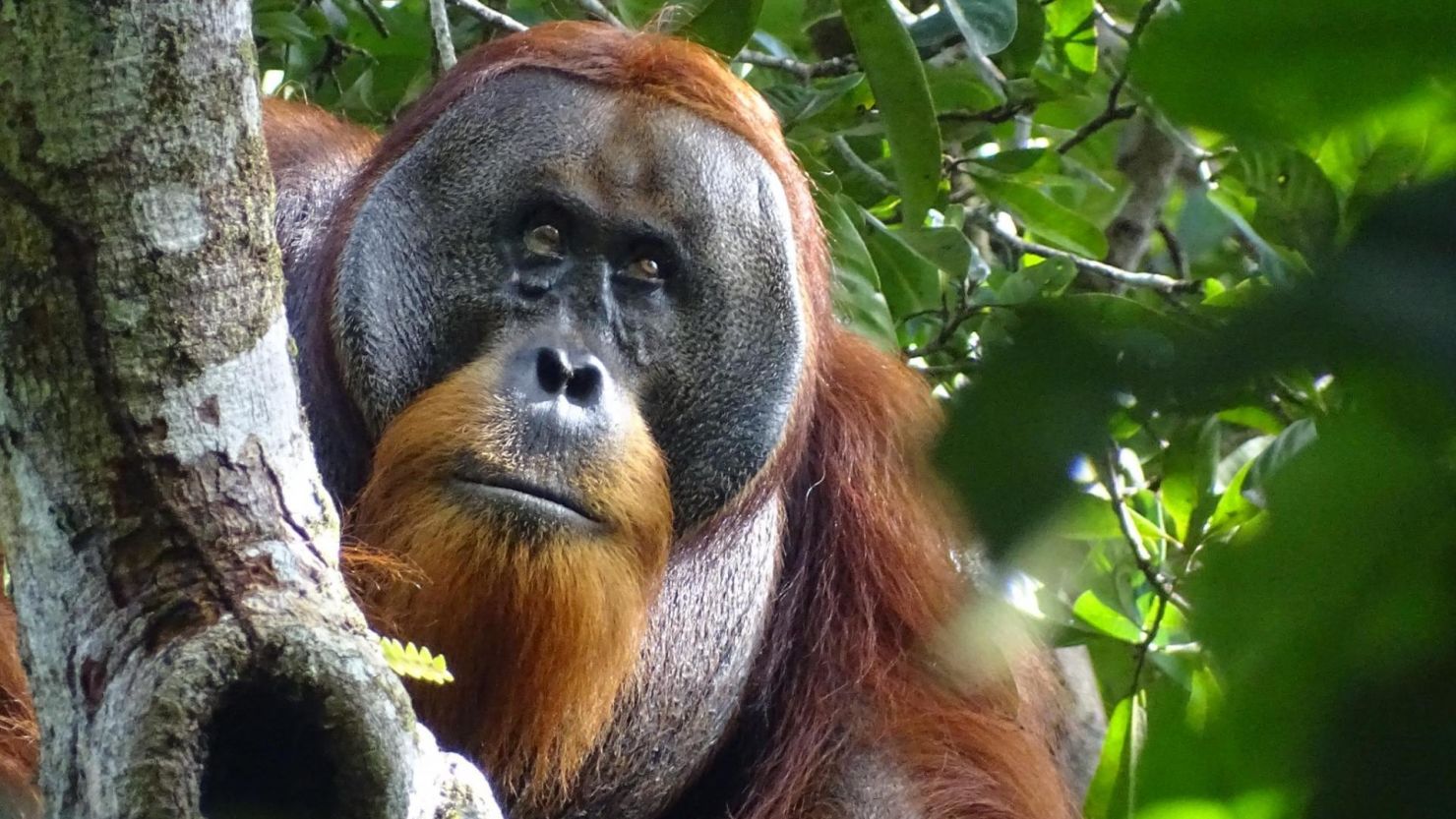
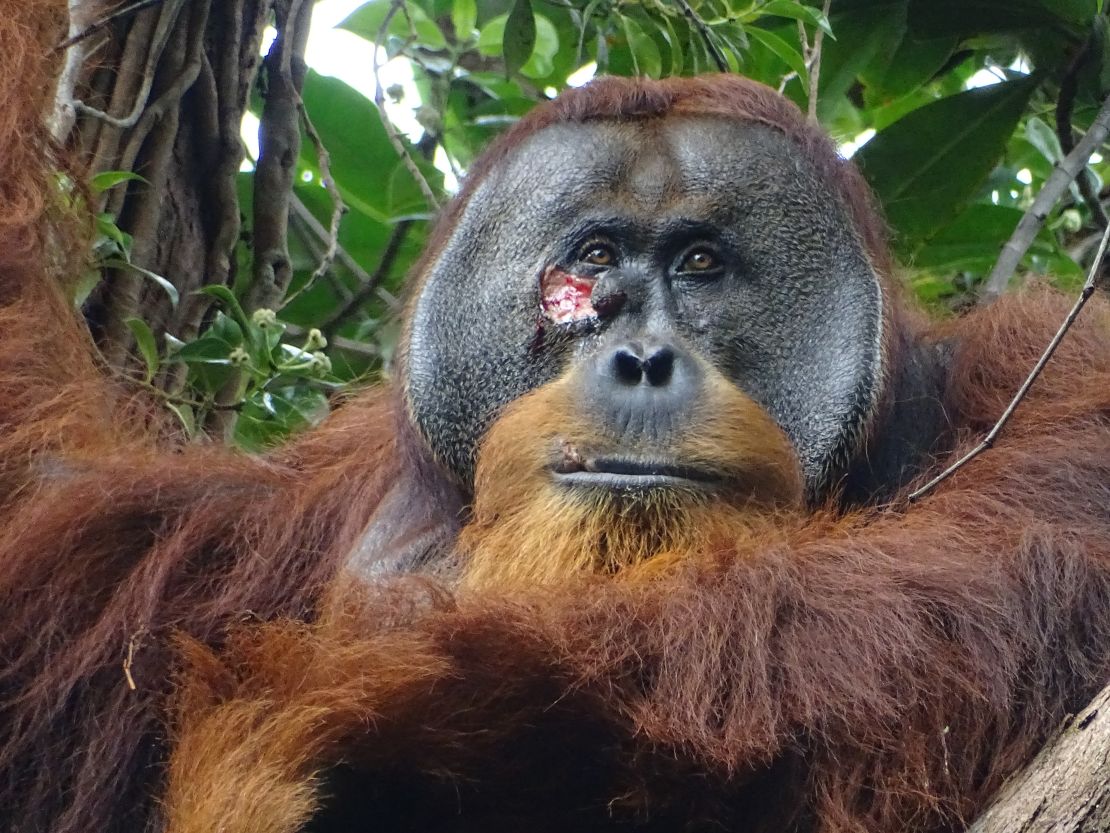
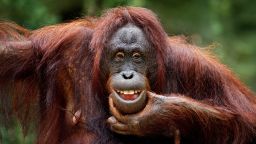
The male Sumatran orangutan treated a facial wound by chewing leaves from a climbing plant and repeatedly applying the juice to it.Armas CNN —
Scientists working in Indonesia have observed an orangutan intentionally treating a wound on their face with a medicinal plant, the first time this behavior has been documented.
Rakus, a male Sumatran orangutan, treated a wound on his face by chewing leaves from a climbing plant named Akar Kuning and repeatedly applying the juice to it, according to a paper published in the journal Scientific Reports on Thursday.
Rakus then covered the wound with the chewed up leaves, which are used in traditional medicine to treat illnesses like dysentery, diabetes and malaria, said scientists.
ADVERTISING
Study lead author Isabelle Laumer, a post-doctoral researcher at the Max Planck Institute of Animal Behavior, told CNN that the team were “very excited” by their observations, which took place in June 2022 in the Suaq Balimbing research area in Gunung Leuser National Park, Indonesia.
Although other wild primate species are known to swallow, chew or rub themselves with plants that have medicinal properties, scientists have never seen them used to treat recent wounds.
Rakus treated his wound in a process that took several minutes, researchers said.Armas
The team believe that Rakus intentionally used the plant to treat his wound as he applied it repeatedly in a process that researchers say took several minutes.
“This possibly innovative behavior presents the first report of active wound management with a biological active plant in a great ape species,” she said.
Researchers believe that Rakus most likely sustained the wound in a fight with another male orangutan, which are rare in the area thanks to “high food availability, high social tolerance between orangutans and relatively stable social hierarchies,” Laumer explained.
This means that orangutans rarely suffer wounds, giving researchers few opportunities to observe this behavior.
As for how Rakus would have learned how to treat a wound, one possibility is “accidental individual innovation,” said Laumer.
The orangutan may have touched his wound accidentally while feeding on the plant and felt immediate pain relief due to its analgesic – pain relieving – effects, making him repeat the behavior, she explained.
Another possible explanation is that Rakus learned how to treat a wound from other orangutans in the area where he was born, said Laumer.
The observation “provides new insights into the existence of self-medication in our closest relatives and in the evolutionary origins of wound medication more broadly,” added Laumer, raising the possibility that wound treatment may originate in a common ancestor shared by humans and orangutans.
Researchers plan to closely observe any other wounded orangutans in the area to see if the behavior is repeated, said Laumer, who added that the findings underline the commonalities between humans and orangutans.
“We are more similar than different,” she said. “We hope this study raises awareness on their critically endangered status in the wild.”
I walk the narrow path along the edge of the lake, through the whiskery sedge and muddy wetland into the beech forest. The indigo sky darkens toward black. Night creatures stir and an owl’s call echoes off the water. I walk on, each footfall sure and deliberate.
I know every hollow and swell of this land. I know how to read the wind. I know the sun and shadow on the water, the yellow greens of spring and dark greens of summer, the scent of a summer storm. I know the phases of the moon.
The humans that share this land with my tribe do not trust us. They call coyotes “tricksters,” but isn’t it they who are prone to taking more than they need, to spoiling the land and water that feeds them, to being far removed from the earth’s rhythms, to sidestepping inconvenient truths? Across the lake I see their house lights reflecting long streaks across the water. I keep my distance from them.
The path meanders upward through a grove of soft grasses, through a white pine forest, over the tumbledown rock walls. I walk on. At the edge of the woods I pause and watch my kin arrive from every direction and converge on the ridge of the hill. Their fur is silver and silhouetted against the rising moon. I join them, touching nose to nose in greeting.
In unison we lift our throats to the sky and begin singing, our voices weaving in and out of each other’s and rising to a crescendo. As the moon rises above the horizon, we sing of summer sun and winter snow, of ancient starlight, of brotherhood. We sing into the wind, our song carrying across the hills. I imagine the humans in the valleys hearing us and sensing something deep and familiar resonating within.
Photos courtesy of Hal Brindley and illustration courtesy of Nixxphotography, freedigitalphotos.net




 Untold Animal Stories