Gracie the Ginger Cat: A Rescue Tale

To View on Substack, please visit: thekindlife.substack.com

Gracie the cat found her way to us when my daughters were young. She had been thrown from a car and made her way to the yard of a kind couple who cared for her. Their inside cat was highly territorial and wouldn’t tolerate another cat, so they sought a home for this ginger-colored cat. Through a friend of a friend, she came to us.

When she entered our house, Gracie was respectful. She moved gently and quietly, her body and pace relaxed. She observed people and animals before doing anything. Our resident cat was unthreatened and curious about her. Our rescue pit bull befriended her, showing his affection by frequently slurping the side of her face. Gracie squinted against it, shook off the spit, and then gazed fondly at the dog.

Gracie connected deeply with my younger daughter in particular and allowed her to do the things that young girls sometimes do: dress the cat in doll’s clothing, push her around in a pram, and drape her over her shoulder and wander through the house.

Gracie seemed to have an understanding of emotional needs of her humans. One example is this: she had always slept with my younger daughter, but the one and only night she changed her routine was when our beloved pitbull died. That night, Gracie divided her time evenly between us, lending her gentle presence by snuggling against us in our beds before moving to the next person.

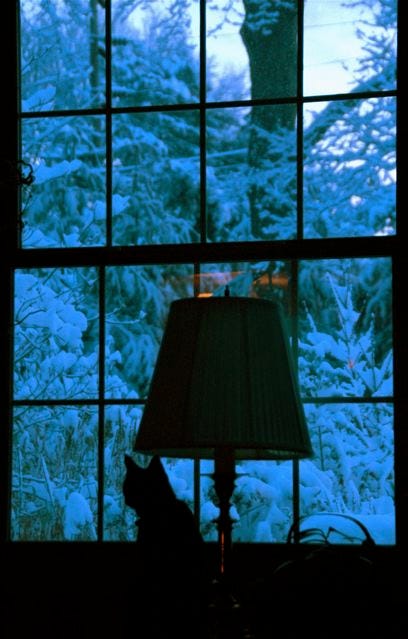
I love this peaceful photograph of her. Gracie sat for a long time gazing out at the twilight snowfall. When she turned, she looked at me, blinked slowly (the cat equivalent of a kiss), jumped down, and sauntered through the house.
Thanks for reading! Subscribe for free to receive new posts and support my work.

Leave a comment

This post is public. Please feel free to share it with anyone who might be interested.

Share

Compassion in Action:

Roughly 6.5 million animals enter shelters in the US each year but only 3.2 million are adopted (ASPCA). Progress has been made: compared to 1973, the number of cats and dogs entering shelters annually is down more than 20 million (Humane World for Animals [formerly Humane Society of the United States]).

If you are in the market for a dog or cat, this site is searchable by location, species, gender, age, color, care and behavior, and whether they’re good with kids, dog, and cats: Find an adoptable cat or dog near you: https://www.petfinder.com/

You See a Dog or Cat on the Side of the Road-Sensible ways to help without getting in over your head

(From Humane Society of the United States) You’re driving your car when you see a dog or cat on the side of the road. With a sinking feeling, you realize they are alone. What should you do?

This is a wrenching scenario for all who care about animals. After all, what if your own pet were standing there? Use our guidelines for providing safe and effective help.

Don’t cause an accident

You can’t help an animal if you become injured in the process. Look in your rear-view mirror before braking, turn on your signal, pull your car completely off the road, turn off the ignition, set the parking brake, and put on the hazard lights. If you have emergency flares, prepare to use them.

Catch them safely

Safety first

A strange, frightened, and possibly sick or injured animal can behave unpredictably. A sudden move on your part, even opening your car door, can spook them and cause them to bolt—possibly right onto the highway. If the animal looks or acts threatening, or if you feel uneasy about the situation, stay in your car.

If possible, restrain the animal. Create a barrier or use a carrier, leash, piece of cloth, or length of rope to keep the animal in the area. Signal approaching vehicles to slow down if you cannot confine the animal, or divert traffic around them if they appear to be injured and is still on the roadway.

Use caution

Use caution when approaching the animal. Should you succeed in getting close enough to capture them, you stand a good chance of being scratched or bitten.

When moving toward the animal, speak calmly to reassure them. Make sure they can see you at all times as you approach, and perhaps entice them to come to you by offering a strong-smelling food such as canned tuna or dried liver.

Lure them into your car

If you are certain you can get help from animal control very soon, try to lure the animal into your car with food, close the door and wait for help. In most cases it isn’t a good idea to attempt to drive somewhere with a strange dog unrestrained in your car; they may become frantic or aggressive. Cats may do the same, as well as lodge themselves under the car seat, and it can be dangerous trying to extract them.

Call for backup

If you’re not able to safely restrain the animal, call the local animal control agency (in rural areas, call the police). Do so whether or not the animal is injured, and whether or not they are wearing an identification tag. Leave your phone number with the dispatcher, and try to get an estimate of how long it may take someone to respond. If possible, stay on the scene to keep an eye on the dog or cat until help arrives. Make sure you report to authorities precisely where the animal is by using road names, mile markers or landmarks.

https://www.humanesociety.org/resources/how-help-stray-pet

He Wasn’t Much of a Hunter

He closes the door of the red pick-up truck, repositions his gun over his shoulder, and sets off into the woods.  Despite trying to ease his weight onto the twigs and leaves, toe first then heel, his footfalls snap and crackle and echo through the pre-dawn forest.

A doe lifts her head from foraging, her button-black nose twitching with scent-taking.  With noiseless ease, she lopes off, her white tail high.  A groundhog stands on the crest of his mound-home squinting into the distance, his forepaws tucked up to his heart, his teddy-bear ears angled forward.  He squeaks and retreats inside his burrow.  A flock of quibbling sparrows wheels off into the sky.  Only the cat remains.   She is motionless except for the white tip of her tail.

The hunter walks on, pausing from time to time, looking around, then moving on.  The cat follows, unnoticed, at a distance.

When the sun has climbed well above the horizon, the hunter sits down on a large, sunny rock.  He opens a thermos of steaming coffee, crinkles flat the wax paper covering his sandwich, and munches thoughtfully, his head angled to the side.  Sun-warmed and drowsy, his shoulders relax and he closes his eyes.

The cats comes closer, soundlessly.  She sits a few feet in front of him and looks up.  The hunter opens his eyes and startles, then feels foolish.  He mutters something about cats—he’s never liked cats.  He glares at the cat and looks into her gold eyes.  She holds his gaze evenly.  He sighs, then he breaks off a small piece of cheese from his sandwich and tosses it on the ground.  The cat eats it and looks up expectantly.  The man breaks off a larger piece and holds it out to her.  She gracefully leaps onto the rock, and with one paw on the hunter’s leg, she gingerly takes the cheese from his hand.  The hunter slides his broad palm down her back, then offers her the rest of his sandwich.

After a while, he gathers his things, slings the gun over his shoulder, and sets off.  The cat jumps down and follows.  Twice he looks back over his shoulder.  He opens the truck door and sweeps his arm wide in a welcoming gesture. The cat jumps in, settles herself on the passenger seat, and washes her face.

Two seasons have passed since I found my hunter.  He wasn’t much of a hunter, really—I could read that much in the way he moved.  It was plain to me that he wasn’t really interested in hunting as much as he was playing a role.  It was also plain to me that he thought he didn’t like cats.  Most people who give cats a chance find they like them after all.

These days I wait by the window for my hunter.  He comes in with a blast of cold air.  I jump down and wind my way around his legs.  He stoops to pet me and says a word or two.  Then we pass a companionable evening in silence.  His gun is in the attic, tucked away forever.


• • • Have you ever rescued an animal?  Please tell us about it: Untoldanimalstories@gmail.com

The Raleigh Dama

raleighI was born under a porch where I nestled with my mother and siblings in the cool, shaded dirt.  We stayed put when she left each night; she didn’t tell us to do so, but she made it clear somehow.  We weren’t inclined to wander anyway—there were odd sounds at night beyond the latticework that separated us from the world.  So we chewed on each other, and climbed on top of each other, and silently curled around each other, awaiting her return.  She came back before first light.  We nursed happily and slept.

One morning there was commotion outside our hideaway.  Our mother stepped in front of us, tense.  There was a wrenching sound, then the latticework fell away and sunlight streamed in.  A man and woman stooped down and peered at us, making friendly little sounds.  My mother, wary, moved toward them, her thin body silhouetted against the glare.  She sniffed their hands then allowed them to pet her.  She turned to us and meowed, and we came to her.  The man gently scooped all four of us kittens up at once in his arms and placed us in a crate.  He called to my mother, who looked at us in the crate, glanced to the side toward freedom, looked at us again, then climbed into the crate.  We pressed against her body on the jostling ride.

We came to a place of meowing cats and barking dogs and talking people.  A woman carried us to a cage in a back room.  Another woman draped our mother across her shoulder, petting her, and brought her to join us.  There was a bowl of water, into which I dipped my nose and sneezed repeatedly.  There was a bowl of food that my mother ate, all at once.  There was a soft blanket on which we slept and passed the time together.

People came and went—tall people and little people, high voices and low voices, kind hands that pet us and fed us.  My mother grew less boney.  We grew bigger.

An older man came one day, white haired and angular.  He opened our cage and petted each of us with exquisite tenderness, then the spoke to our mother.  They regarded each other for some time, as though something was passing between them.  Before he took her away, he held her near each of us.  We touched noses with her, and then she was gone.

Two days later, two of my siblings were adopted by a young couple, and three days after that, my remaining sibling was adopted.  The cage had a lot of space to move in, but I missed the sense of belonging and deep comfort that came from my family’s nearness.  The people who cared for me were kind, picked me up, and spoke to me, but mostly they were bustling about caring for so many cats.

At night the shelter grew quiet and peaceful.  The moon came through the bars of my cage, bluing the floor and my black fur.  In its soothing light, I slept deeply.

One day a woman came and paused before each of the cages.  I liked the way she moved, like a blade of tall grass in the wind.  She lay her open palm against the door of each cage and talked softly to the cats.  When she came to my cage I stretched my arm out toward her and blinked slowly—the language of cat love.  She asked someone if she could hold me.

When the door swung open, I walked into her outstretched arms, settled in, and reached up and touched her face with my paw.  She laughed, a lovely, silvery sound, stroked my fur, and said something to the shelter person.  I went home with her.

Sometimes I dream of my mother and siblings, a far-off memory now.  In my dreams each of them has someone to love.

Some have the mistaken belief that shelter cats aren’t adoptable, that they’re in the shelter for behavioral and other problems.  Generally this is not true.  Cats land in shelters because 2% of lost cats ever find their way home… because unscrupulous owners abandon them…because their people die…. Please consider adopting from a shelter.  There are 70 million homeless cats in the U.S.

About www.untoldanimalstories.org —We tell animals’ stories from their perspectives.  Gentle in our approach rather than shocking, we invite connection, compassion and, from that, action.  We also provide tips on what you can do to help animals, and seek new action ideas, as well as animal and rescue stories, from you….  Please write to us at untoldanimalstories@gmail.com