
Never, never be afraid to do what’s right, especially if the well-being of a person or animal is at stake. Society’s punishments are small compared to the wounds we inflict on our soul when we look the other way” – Author Unknown
How this rapper quit his music career to start a cat rescue
“I think something as selfless as rescue could be an example to the world of unity and working together,” said Sterling Davis, a.k.a. the TrapKing.

Sterling Davis, aka The Trap King.Weir MediaNov. 29, 2020, by Jen Reeder
This story was originally published on Today.com.
Atlanta resident Sterling Davis was on a break from a rap tour when he applied for a job at the county shelter scooping kitty litter. He just wanted to stay busy and make a little money. Plus, he’s always loved animals, like his cat at the time, Rick James.
“I did horrible in the interview because they had cats in the room and I was playing with all the cats, kissing all the cats,” he told Today.
Even though he didn’t really answer any of the questions because he was distracted by the friendly felines, he got the job because, as the person who hired him said, “We’re not seeing people like you with cats.”
Davis, 40, started helping shelter employees with trap-neuter-return cases. The team would trap community cats (formerly called “feral”), bring them to the shelter to be vaccinated and spayed or neutered, and then return them to their outdoor realm.
While Davis learned about TNR, he came to another realization.
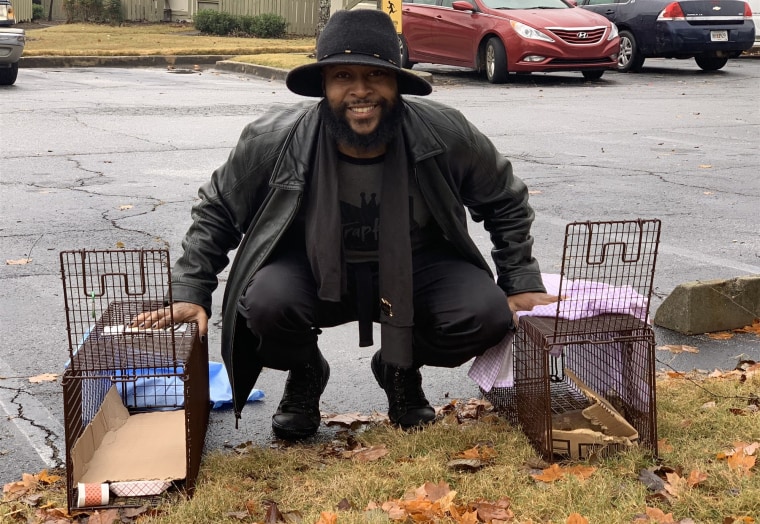
“At the county shelter, there were no men and no Black people that worked in the cat department,” he said. “When I would go out and do TNR with all my friends, it would be all women — that’s who trained me. I finally asked the difficult question: ‘Where are all the guys and where are all the Black people?’’
The answer: There’s just you.
Davis realized he had a new calling. He let his band know he would not be coming back on tour. Instead, he was going to devote all his time to cat rescue as the TrapKing.
After five years of working at the shelter run by LifeLine Animal Project and training with Best Friends Animal Society, Davis founded the nonprofit TrapKing Humane Cat Solutions in 2017.
His bold goal: to change stereotypes of men in cat rescue and bridge the communication gap between Black communities and predominately white animal welfare organizations.
“I’ve seen rescue be something that’s looked at as hard, tedious, sad,” he said. “If people can see me and I make this look like this is a rock-star type life, this is fun — you can do it.”
When his music money dried up, Davis sold everything he owned and bought a conversion van to live in to help pay for cat surgeries and support his nonprofit. He plastered the van with TrapKing logos and people started noticing. He hosted contests for kids, who would watch his humane traps. Whoever texted him first about a cat in a trap won $20, second place got $15 and so on.

“I started going into neighborhoods and kids would see me like the ice cream truck,” he said with a chuckle. “I would pull into apartment complexes and see young boys running up to the van trying to give me cats. ‘Hey Trap, look — I got a cat. Do I get some money?’”
As the TrapKing became better known, opportunities arose. The Atlanta Humane Society offered to spay and neuter cats he brought for free, which was a huge help since he wasn’t charging anyone for his services.
Davis, who enlisted in the Navy right out of high school and served for two years as an operations specialist manning the ship’s radar, said he believes his experiences have helped him connect with people from all walks of life as the TrapKing.
“I think being in the military, being around different people, different cultures and being in entertainment is what actually helped me better communicate with all types of people and better communicate this mission,” he said. “I’ve literally been pushing to make TNR community cat care as common as recycling and get more people engaged in so many fun ways.”
It hasn’t always been easy. Early on when Davis was returning cats to a predominately Black neighborhood, a group of men walked up and told him: “White people put tracking devices and diseases in these cats to hurt the Black community and you’re helping that. You’re bringing them into the neighborhood.”
“I was like, ‘Wow, that’s so wrong.’ It was really difficult to explain it because all the Black community could see was this is a white person’s thing,” he said.
Over time, perceptions have changed. When protests erupted across America in the wake of the killing of George Floyd, Davis launched a T-shirt campaign called “Allies in Rescue, Allies in Life.” He announced he would donate all of the funds to the nonprofit Campaign Zero, which promotes policy changes to end police violence. Support from rescue advocates and organizations was overwhelming.
“I got a lot of feedback from the Black community on that, like, ‘So you got all of these animal people to donate to issues other than just cats or dogs?’” he recalled. “I’m like, ‘Yeah — we’re allies in rescue and allies in life.’ So that really turned a lot of things around.”
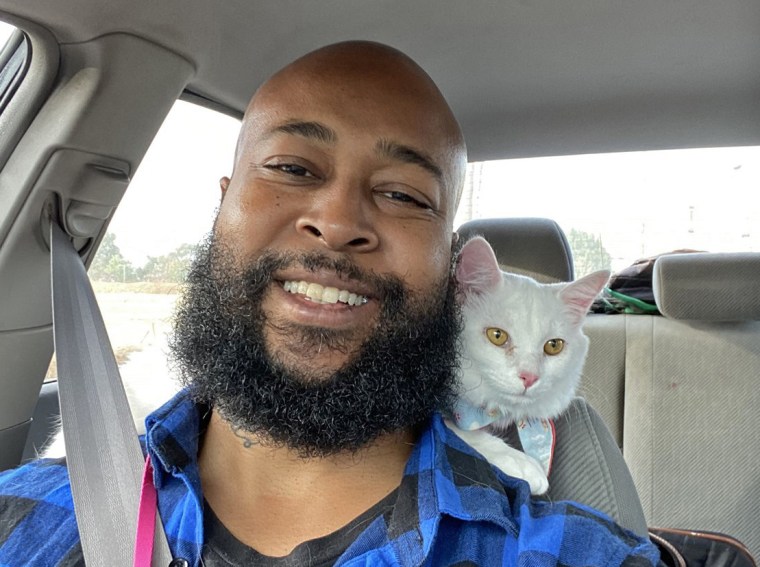
Davis now runs TrapKing Humane Cat Solutions from an RV, which he shares with his cats Bowie, Damita Jo and Alanis Mewissette. He hopes to travel across the country soon promoting TNR and fundraising for animal shelters. He’s also pushing for the Boy Scouts and Girl Scouts to start offering a TNR badge.
Through it all, he’s continuing his outreach to communities and modeling his motto, “You don’t lose cool points for compassion.”
“I’ve had a lot of parents reach out to me and say that their son gets made fun of because he likes cats,” he said. “I just want it to be known that you cannot lose cool points for compassion. If you are doing something compassionate, you gain cool points.”
The TrapKing would love to see the rescue community find ways to put aside any differences and work together toward the common goal of saving the lives of pets.
“I think something as selfless as rescue could be an example to the world of unity and working together,” he said. “So I want to put that out there.”
Rescue in Crete
Sam Wilson is a volunteer at https://www.facebook.com/GeorgeShelterCrete/ She is a former police inspector with Nottinghamshire, England police. She served on the force for 30 years and retired in September 2020. A week later, she flew to Crete, Greece to volunteer with George Orfanidis and his George Stray Dogs organization. Sam’s plan was volunteer for four weeks, improve her Greek language skills, and then return home. The return-home part of her plan became complicated. Her time there inspired her to book three additional flights to Crete over the following two months, with more planned in the future. Sam now has a very long commute to work and works side by side with George.
George Stray Dogs was founded by George Orfanidis, who has devoted more than 20 years to rescuing and caring for dogs and bringing about positive change for animals by changing people’s minds and hearts through education. George houses 100 dogs at his shelters, which lack electricity and water supply. Every day, without fail, he drives the 70 km round trip bringing water and food to the dogs.
Animal welfare is not a priority in Greece. There are estimated to be 8 million stray dogs and cats in the country. They are routinely abandoned in the rubbish, in the mountains, and on the street. Some dogs are chained to barrels for the length of their lives, with little food and fresh water, and riddled with ticks, fleas, and worms.
George has been reliant on his fellow Greeks for donations for food for veterinary medicine, but Greece has been in recession for a long time. Many of the people who care about animal welfare have little money to give. The struggle for funding was somewhat alleviated when Australian animal activist Stella Savvas set up the organization’s Facebook page. George has also received various volunteer assistance from his brother Nikos Orfandis, and volunteers Katerina and Debra. The organization also received a boost when George’s friend, well-known Greek rescuer Takis Proestakis, mentioned him on his FB page.
The access to a wider audience has allowed George to build infrastructure at one of the shelters, which will allow all of the dogs to be housed at one site. Fencing, kennels, and easy access to water will make the rescue work easier. George, Sam, and other volunteers are currently working to complete the site work before winter sets in.
Some of George Stray Dogs rescue success stories – Before and After:
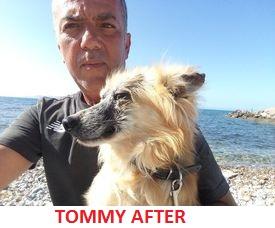
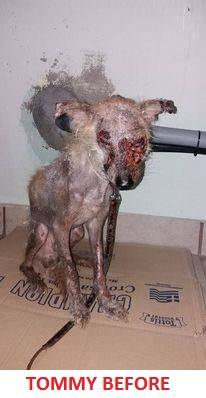
Tommy – George found Tommy in the filth of an abandoned house. The sight of Tommy reduced George to tears. Tommy had little fur and wounds all over his face and body from the effects of leishmaniasis, a parasitic disease which afflicts many dogs in the southern Mediterranean. After months of care, love, and treatment, Tommy was transformed into a beautiful dog. Tommy and George are now inseparable.
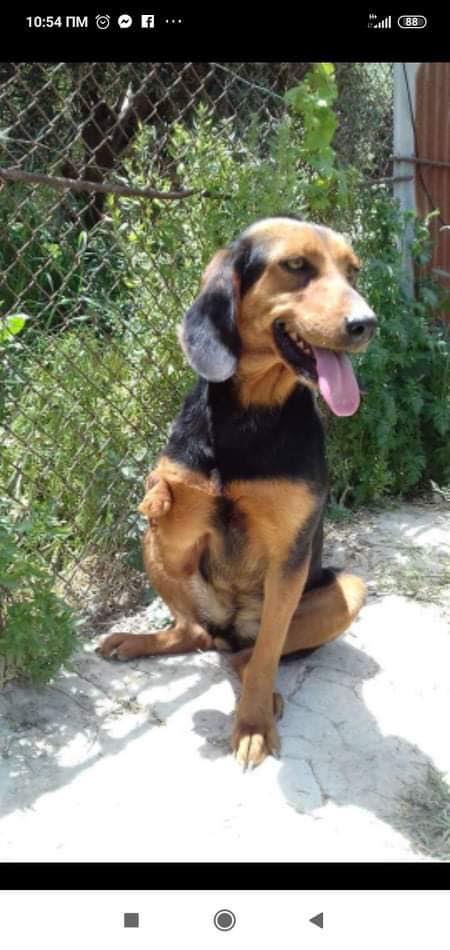
Hara – Hara was abandoned in the rubbish five years ago. George was caring for her as a stray on the streets. One day, he was alerted that some men had her on a chain and were ready to hang her. George went to the location and fought with the men to save her life. (He has been attacked more than one occasion for his work.) The men damaged George’s car and bruised him, but Hara was saved and she now lives at the shelter. Hara is a contented dog with a sweet and gentle nature. The deformed leg with which she was born causes her no issues.
Dias – Dias is known as the Gentle Giant. He is a 60kg Greek Shepherd found on the highway with shattered legs, unable to move. With two surgeries and care from George he is thriving. The puppies particularly adore him. He’s the alpha dog in his pen but calm and even natured with others.
The transformation of dogs from when they arrive at the shelter in heart-breaking condition to health, balance, and friendly dispositions. They form close bonds with each other and adore George. George has a huge heart, dedication, and deep compassion for the neglected, abused, abandoned, tortured animals on Crete, Greece.
If you would like to make a donation to George Stray Dogs, their Paypal account is
George Stray Dogs also have a Go Fund Me to raise money for a 4×4 car to provide consistently reliable transport to the shelter in winter.

For further information: https://www.facebook.com/GeorgeShelterCrete/
A Movie that Could Change People’s Ideas About Animals’ Ability to Think, Reason, Feel
Steps to Take To Help a Stray or Lost Dog
Most people assume that a wandering dog is owned and/or temporarily lost and will find his or her way home, but many do not. Rather than assuming things will work out for the dog, consider taking action. Yes, it’s a tad inconvenient for you, but what you’ve done is save a lost or abandoned animal from dehydration, starvation, exposure to the elements, fighting over scarce resources, and injury from animals or automobiles.
Here are some safe ways to help lost dogs.
If the dog is friendly:
- If the dog seems friendly and is willing to come to you, call him, and slowly move your hand forward palm down (palm up can signal that you might strike). Exude a calm confidence rather than fear. Talk to him, let him sniff you, and then stroke him gently.
- If he has a collar read the info and make the appropriate call.
- If he does not have identification, see if he will enter your (often calling him and simply opening the car door will inspire him to jump in) or corral him into an enclosed area, like a fenced yard or a room in your house. Provide water and food.
- Call your local SPCA, humane society, or police to notify them that you have found a lost dog. To find the number of your local animal rescue organization, search by “animal shelter,” “humane society,” or “animal control.” Public animal care and control agencies are often listed under the city or county health department or police department. You can use this link to find animal rescues in your area: https://www.petfinder.com/animal-shelters-and-rescues/search/
- Either deliver him to the shelter (where they can check him for a microchip with identifying information) or ask that someone pick him up.
- If you choose to retain him while searching for the owner, staple easily readable flyer (if possible, with photo) on telephone polls, put a free listing in the local paper and in the “pets” section of Craig’s list, rubber band a flyer to neighbors’ mailbox flags, and provide the local animal shelter veterinary offices with his identifying features so that they can check their database for a match.
If the dog seems unfriendly:
- If the dog seems unfriendly, do not put yourself at risk. Immediately call the police and your local animal rescue organization with information on his last-seen location.
- Put down a plastic, disposable bowl of water and food, which not only will slake his thirst and hunger, but help to keep him in that location so that authorities can find him.
Thank you for doing what you can to help animals.
Click Daily & Corporations Will Provide Food for Animal Shelters – Free To You
Animal rescue – corporate food donation
If interested, you can make this you home page, so that when you log onto the internet, you can click daily. It costs you nothing.
Here are instructions to do so, for various browsers:
Firefox
- Open Firefox, then select the three, horizontal lines next to the profile icon.
- Select Options, then select the Home icon.
- Under New Windows and Tabs, select the dropdown next to Homepage and new windows.
- Choose the option you prefer: Firefox Home (Default), Custom URLs, or Blank Page.
Safari
-
Open Safari, then choose Safari > Preferences, then select General.
-
In the Homepage field, enter a wepage address. To simply use the webpage you’re currently viewing, select Set to Current Page.
-
Choose when your homepage is shown.
-
Open new windows with your homepage: Select the New windows open with pop-up menu, then choose Homepage.
-
Open new tabs with your homepage: Select the New tabs open with pop-up menu, then choose Homepage.
-
Microsoft Edge
- Here’s how to change your home page in the new Microsoft Edge :
- Open Microsoft Edge, select Settings and more > Settings .
-
Select Appearance.
-
Turn on Show home button.
-
You can either choose New tab page or select Enter URL for a page that you want to use as your home page.
- Note: This topic is for the new Microsoft Edge . Get help for the legacy version of Microsoft Edge .
Internet Explorer 11
- In the top corner of Internet Explorer, select Tools , and then select Internet options.
- On the General tab, under Home page, enter the URL of the site you want to set as a homepage. You can add more than one URL. Or, to add the site you’re currently viewing, select Use current. If you add more than one URL, put each URL on its own line.
- Select Apply, and then select OK
Corporate Sponsors Will Donate Food to Animal Shelters for Each Click
You can click this link (up to 4x daily–free to you) and corporate sponsors will donate food to animals shelters: https://theanimalrescuesite.greatergood.com/clickToGive/ars/home
Petition to Ban (Incredibly Cruel & Dangerous) Wet Markets
Please consider signing this petition: click to view and sign
Threat to Public Health
Animal Equality has launched a worldwide campaign and petition calling for the immediate closure of wet markets across the globe. Wet markets get their name in part from the blood, guts, scales and water that soak the stalls’ floors, remnants from animals brutally killed for customers who desire to eat freshly killed meat.
In exclusive footage shot by Animal Equality at wet markets in China, Vietnam and India, animals such as deer, raccoons, crocodiles, and dogs are shown living in filthy conditions, suffering from dehydration, starvation and disease.
These markets are also a threat to public health and have been the source of documented disease outbreaks in the past, including SARS. Researchers also believe COVID-19 most likely originated from a wet market in Wuhan, China, notorious for trading in wild animals.
It is because of the public health crises wet markets cause, as well as the intense suffering inflicted on farmed animals, that Animal Equality is urging the United Nations to ban all wet markets. Not only do these markets pose an immediate danger to humans, but they are also intensely cruel and abhorrently inhumane to animals.
“I think we should shut down those things [wet markets] right away. It boggles my mind how when we have so many diseases that emanate out of that unusual human-animal interface, that we don’t just shut it down. I don’t know what else has to happen to get us to appreciate that.”
Director of the National Institute of Allergy and Infectious Diseases.
“If you take wild animals and you put them into a market with domestic animals or other animals, where there’s an opportunity for a virus to jump species, you are creating … a superhighway for viruses to go from the wild into people. We can’t do this anymore. We can’t tolerate this anymore. I want the wild animal markets closed.”
Infectious Disease Expert
“The animals have been transported over large distances and are crammed together into cages. They are stressed and immunosuppressed and excreting whatever pathogens they have in them. With people in large numbers in the market and in intimate contact with the body fluids of these animals, you have an ideal mixing bowl for [disease] emergence.”
The Zoological Society of London
Petition for Banning Animal Cruelty Videos on TikTok
 Please consider signing this petition requesting TikTok to ban animal cruelty videos.
(Note: the photo in this post is a mild photo)
WHO calls on nations to end wildlife markets
@WHO is calling on nations to end wildlife markets because of the high risk they pose for the spread of pathogens like the coronavirus that can jump from animals to humans.

World Health Organization says nations should end wildlife trade · A Humane World
The World Health Organization is calling on nations to end wildlife markets because of the high risk they pose for the spread of pathogens like the coronavirus that can jump from animals to humans….
 Untold Animal Stories
