The Urge to Adopt a Dog

I was walking in the fields the other day when I was overtaken by a strong, intruding thought: I want to adopt a dog. Wait, what? said I to myself. I’d already decided two years ago not to adopt another dog. I tried to put the thought aside, but it stuck with me.

My last rescue dog, Finn, passed suddenly in 2023. Finn’s death deeply saddened me—he was a sweet, special needs dog rescued from horrible conditions in Alabama. He had survived distemper as a puppy—the survival, a rarity—and had gait issues because of it. The “owner” of the 300-dog place from which Finn was rescued was jailed for animal abuse—another rarity. Finn was leery of everyone but family and close friends. There was no meanness to him. He was a gentle presence who emanated kindness and got along fabulously with my two cats.

At the time of Finn’s death, I was in the midst of helping my partner navigate a terminal illness. Overwhelmed by hospital visits, the impending trajectory, and care for my partner, I decided that I would stick only with my cats, who are loving, entertaining, and easy to care for. So sure was I that I had the ugly chain link dog fence, which came with the house when I bought it, removed.

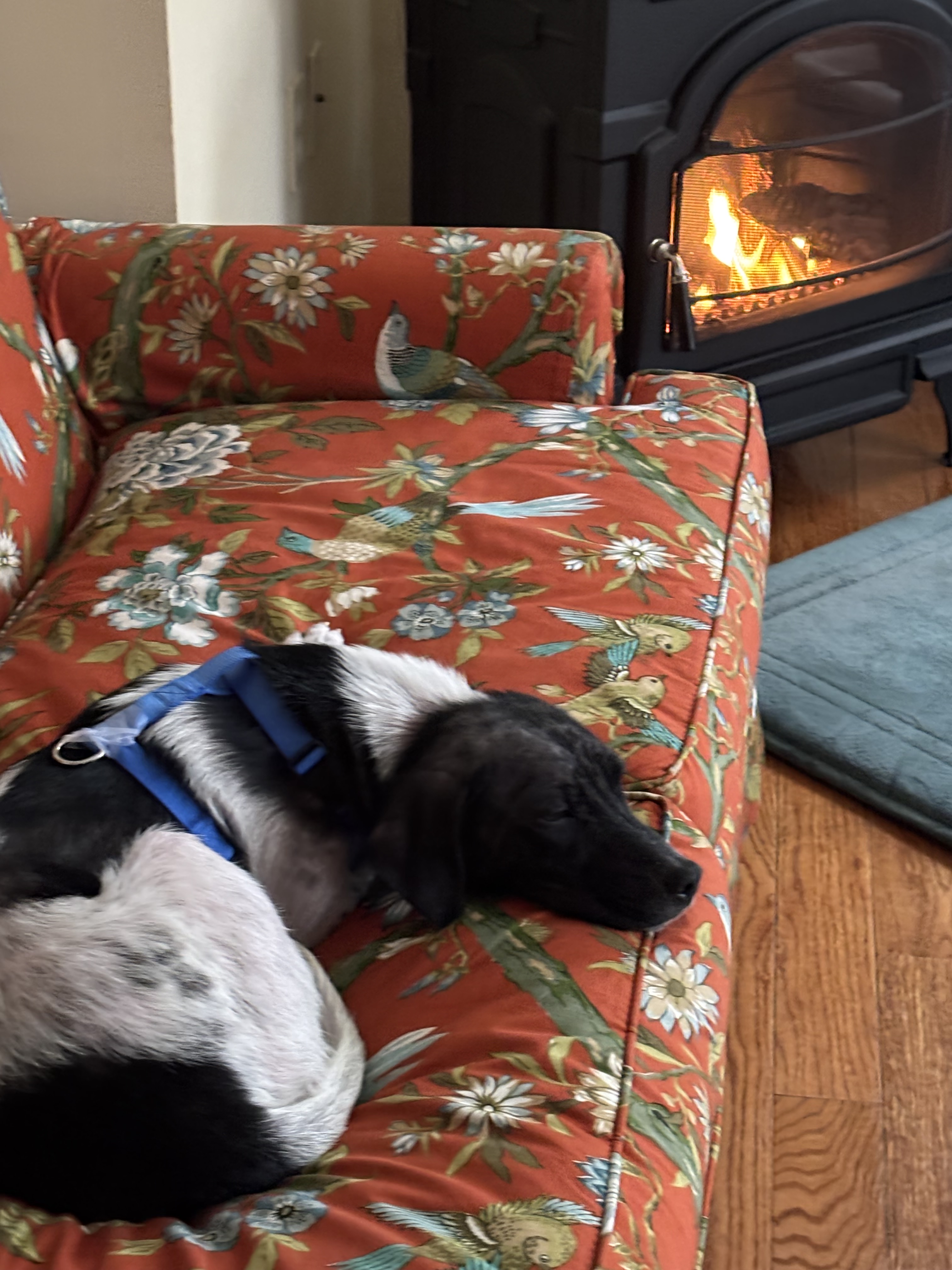
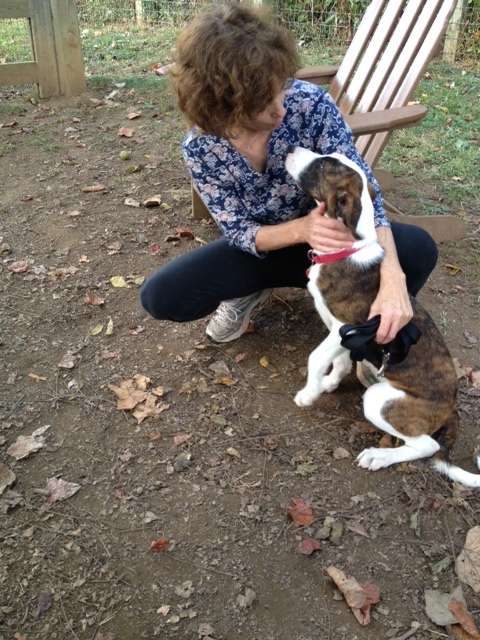
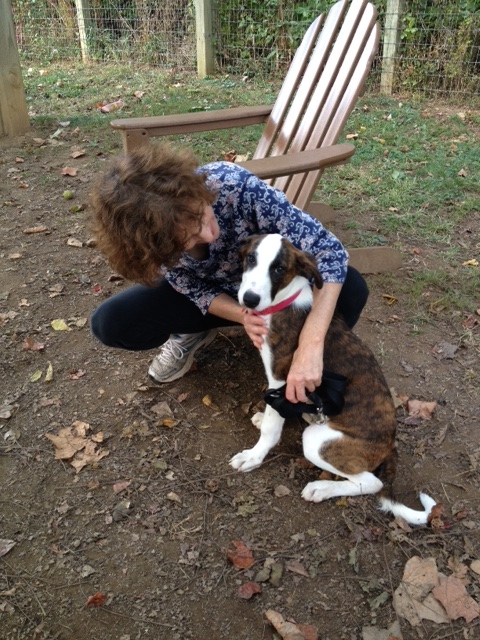
Rescue organization – https://hindeanimalrescueteam.org/ – photos (above and below). Her fur has mostly grown back now.

Two years later came the inconvenient, unbidden recognition that I wanted to adopt a dog. After fighting the urge for a good week, I looked on petfinder.com at rescue dogs known to be friendly with cats. I perused hundreds of adoptable dogs (my god, there are so many rescue animals, including purebreds, that need homes; please consider adoption rather than buying from a breeder). I kept coming back to one and only dog, who met none of the criteria I had in mind. This particular dog is 9 months old (I wanted an older dog), much smaller than I had in mind (I wanted a dog the size of a pit bull or lab), and she was missing patches of hair from neglect, a bacterial infection, and exposure to the winter elements in West Virginia where she and her sisters were tied up, without shelter I believe. But there was something about the pup—maybe the look in her eye?—and I felt some ineffable connection with her. I called the rescue, talked at length to the foster parents, and arranged a “meet and greet” visit at my home. It went very well, and she was very respectful of the cats.

I pick up the pup in less than two weeks. I already have the vet appointment lined up, a new fence in the process of installation, and I repurchased all of the dog necessities I had donated two years ago. I cannot wait to welcome her into the family!

She made herself quite at home

10 Reasons to Adopt a Cat

Cats make up approximately 70% of shelter population. It’s sort of obvious what you should do…ADOPT! Don’t Shop! There are many advantages when it comes to adopting cats from shelters. Many are already spayed or neutered. They are also current on their shots. Shelter volunteers are there for one reason: the good of the animal. They aren’t interested in a profit and any donation you make goes right back into helping more animals in need. I love cats, how about you?

by Julie E.H., Animal Rescue Site blog
theanimalrescuesite.greatergood.com

Part III – I Came from the Deep South

IMG_1424 - Version 3I’ve had two names in my time.  Maybe three, if you consider no name a name.  At the beginning I was part of a brood of too many puppies in an overpopulated, under-inoculated part of the world: rural Alabama.  I was named Delaware by my rescuers, who named the 50 of puppies each a state name.  One day when I was four months old, I became Lucy.

People walked through the rescue’s kennels every day.  Some were caring for us, some were looking to adopt one of us.  I noticed a woman walking through with the shelter director.  The woman was talking about wanting an older dog.  Oh well, I thought.  When the woman walked by our kennel, I sat down and looked up at her, willing her to choose me, choose me, choose me.  We locked eyes for a moment, but she walked on.  Seconds later the woman backed up, as though drawn backward by an invisible force.  I like to think it was my intent.  She leaned down and put her fingers through the gate.  I looked into her eyes and gave her fingers a gentle slurp.  The woman sighed, slid her eyes to the side, looked back at me, then walked on.  I watched her as she went through the swinging door and disappeared from sight.  I turned back to my kennelmates.

A half-hour later, the shelter director came back, clipped a leash to my collar and led me to an outdoor pen where the woman was saying patting Jenny, the sweet black pitbull who had been in the shelter longer than I had been.  She watched the pitbull leave then turned to me and smiled.  As I ran up to her, she stooped down to greet me.  Mine.
   …to be continued.   Part I     Part II

IMG_1422IMG_1425IMG_1424

Wink

as told by Kim Kemple Cott

winkWink came into our lives one day when my mom, Helen, was attempting to adopt a different dog than Wink.  Six months after her rescue dog, Zac the Vizsla, passed on, my mom starting looking with very specific criteria: the dog had to be a small, manageable size and had to be a rescue.

I’d been helping her search for a month by contacting local SPCAs and humane societies and by checking on www.petfinder.com (as of this writing, petfinder.com is featuring 332,076 adoptable pets from 13,476 adoption groups nationwide).  The right dog hadn’t shown up yet.

A friend suggested we try a particular rescue organization in the next county over.  I called my mom, picked her up, and we headed out there.  We got lost en route, stopped to ask for directions, were given directions to a different rescue, and got lost again.  After getting lost a third, time, we asked a police officer.  He wasn’t sure where the rescue was but said that he’d find out.  He pointed us the right way and we arrived after having wandered through much of the county.

We walked up and down the aisles, drawn by so many sweet animals.  We settled on a little brown dog and went to the front desk to provide them with the kennel cage number.  While we were waiting in line, my mom noticed a small black dog sitting in the office of one of the shelter workers.  My mom and I looked at each other, both somehow knowing: this was the dog.  My mom asked about him and was told he was up for adoption; he’d just had his eye removed the day before (kids had beaten him  and he was found lying under a front porch).  One of the shelter workers had taken a particular interest in this Pomeranian/Chihuahua mix, named him Eduardo, and cared for him personally.

As part of the shelter’s adoption process, my mom’s landlord had to be called to verify that he allowed pets.  He was unreachable.  This was a problem, because we really, really wanted to take the dog home that day.  We explained to the shelter worker that the landlord had already given verbal permission, that my mom had a previous rescue dog living there, etc.  The worker looked into my mom’s eyes, then into mine and said she’d be back shortly.  We waited anxiously.wink black and white

She came back, stacking the adoption papers into a tidy pile, saying, “Everything is in order,” and winking at us.  We smiled conspiratorially, signed the papers, picked up the pup, and headed home.

He was tentative and scared at first, but well behaved, and he bonded quickly with my mom and me.  Mom named this sweet creature Wink.  She took him everywhere to help him socialize with people and dogs.  So many people were kind to him.

One day my mom took him into a consignment shop.  The shopkeeper said, “We don’t allow animals in our store.”  Mom smiled warmly, leaned in, and said, “I know, and isn’t it so nice that you let me bring him in here.”

•   With so many good, adoptable pets available—and with an average of 1 in 4 pets in humane societies nationwide being purebreds—why not consider adoption rather than supporting the supply-demand cycle of pet breeding.

•   From the American Humane Society: It is a common myth that pet overpopulation means there are “not enough” homes for all the shelter animals. In reality, there are more than enough homes, but not enough people are choosing to adopt from a shelter. Seventeen million Americans acquire a new pet each year—more than double the number of shelter animals. Only 3.5 million people, or about 20 percent, choose to adopt their new pet. The rest choose to buy their pets from pet stores or breeders, or they choose a variety of other cheap or free sources. 

Despite increased public awareness over the past 40 years about the need to spay and neuter pets, 35 percent of pet owners in the U.S. still choose not to do so. Many among this group intentionally choose to breed their pets, either for profit or for what they mistakenly believe to be a “fun” experience. Others choose not to spay or neuter out of ignorance, believing that their pets won’t breed accidentally.