Gracie the cat found her way to us when my daughters were young. She had been thrown from a car and made her way to the yard of a kind couple who cared for her. Their inside cat was highly territorial and wouldn’t tolerate another cat, so they sought a home for this ginger-colored cat. Through a friend of a friend, she came to us.
When she entered our house, Gracie was respectful. She moved gently and quietly, her body and pace relaxed. She observed people and animals before doing anything. Our resident cat was unthreatened and curious about her. Our rescue pit bull befriended her, showing his affection by frequently slurping the side of her face. Gracie squinted against it, shook off the spit, and then gazed fondly at the dog.
Gracie connected deeply with my younger daughter in particular and allowed her to do the things that young girls sometimes do: dress the cat in doll’s clothing, push her around in a pram, and drape her over her shoulder and wander through the house.
Gracie seemed to have an understanding of emotional needs of her humans. One example is this: she had always slept with my younger daughter, but the one and only night she changed her routine was when our beloved pitbull died. That night, Gracie divided her time evenly between us, lending her gentle presence by snuggling against us in our beds before moving to the next person.
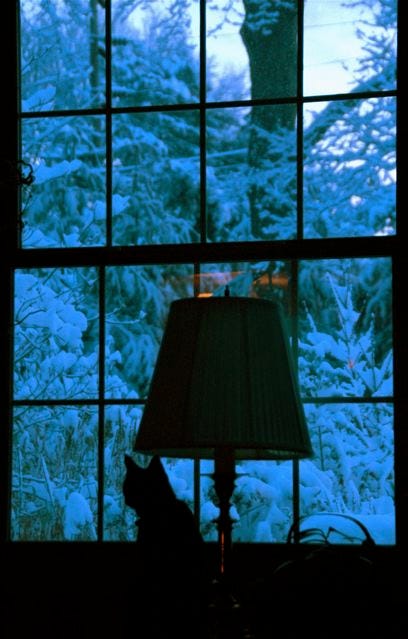
I love this peaceful photograph of her. Gracie sat for a long time gazing out at the twilight snowfall. When she turned, she looked at me, blinked slowly (the cat equivalent of a kiss), jumped down, and sauntered through the house.
Thanks for reading! Subscribe for free to receive new posts and support my work.
Roughly 6.5 million animals enter shelters in the US each year but only 3.2 million are adopted (ASPCA). Progress has been made: compared to 1973, the number of cats and dogs entering shelters annually is down more than 20 million (Humane World for Animals [formerly Humane Society of the United States]).
If you are in the market for a dog or cat, this site is searchable by location, species, gender, age, color, care and behavior, and whether they’re good with kids, dog, and cats: Find an adoptable cat or dog near you: https://www.petfinder.com/
I have loved dogs all of my life, but because my parents wouldn’t allow one in the house, I had to wait until I was out of the house and married before getting one. Since then, many dogs have been in my life, and all but one have been shelter dogs.
The one non-shelter dog was a retired show dog—a Cavalier King Charles Spaniel. She was a beautiful 10-year-old, extremely affectionate dog who, like all the dogs in my life, quickly bonded with me. After three months, she suddenly collapsed and died.
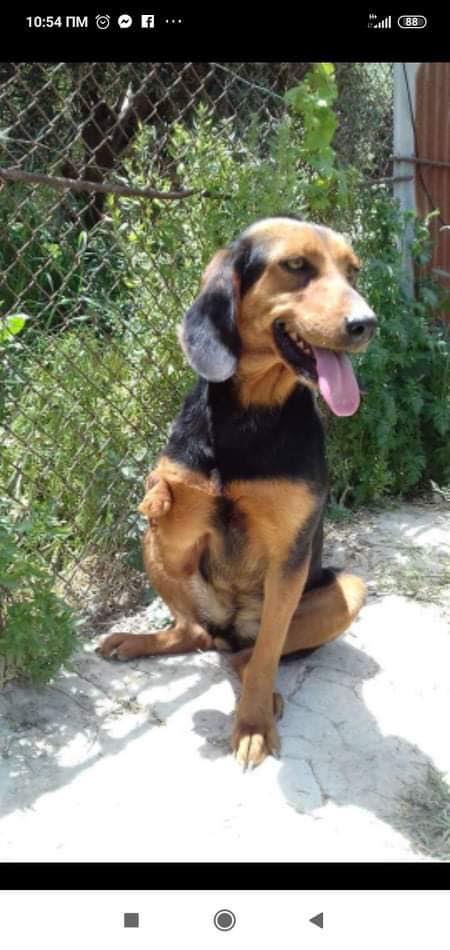
Afterward, my daughters began sending me photos of dogs from local shelters. One that caught my eye was a mixed-breed rescue named Sheba, thought to be under six years of age. She reminded me of my first dog, Prince, a Springer Spaniel mix who bonded with me instantly and seemed always to know want I wanted him to do without being asked. He also knew when I was coming home, although my arrival times varied. When we walked, he was at my side, never needing a leash.
Sheba’s adoption records showed that she had been seized by authorities in West Virginia “from a bad situation.” Like so many rescue dogs from the South, she was transported to the North for adoption. I adopted her in June 2023 through a local rescue, Hinde Animal Rescue in Media, PA.
Sheba
Sheba bonded with me quickly, but her mistreatment caused her to be terrorized by almost everything and everyone else. When I stopped to talk with neighbors on our daily walks she would whimper and pull away. Traffic frightened her, as did anything sudden or different. With me, Sheba was calm. I felt honored to be trusted by her and sought ways to expand her sense of safe. A dog psychologist evaluated her but was unable to help her beyond prescribing Fluoxetine, which had to be halved due to side effects.
The elements of time and loving patience seem to have helped the most. It’s been two years since I adopted Sheba, and she now sits or lies down patiently when I talk to neighbors, and her fear of traffic has passed. She is a low-energy, calm dog who loves to walk slowly, doesn’t pull, and walks with a slack leash. She refuses to play fetch, and when I throw a ball for her, it is I who has to retrieve it. Sheba smiles when she looks at me and has become the love of my life. She has become the companion that she is because she lives in a consistently loving environment. I suspect I have derived as much comfort from living with her as she has from living with me.
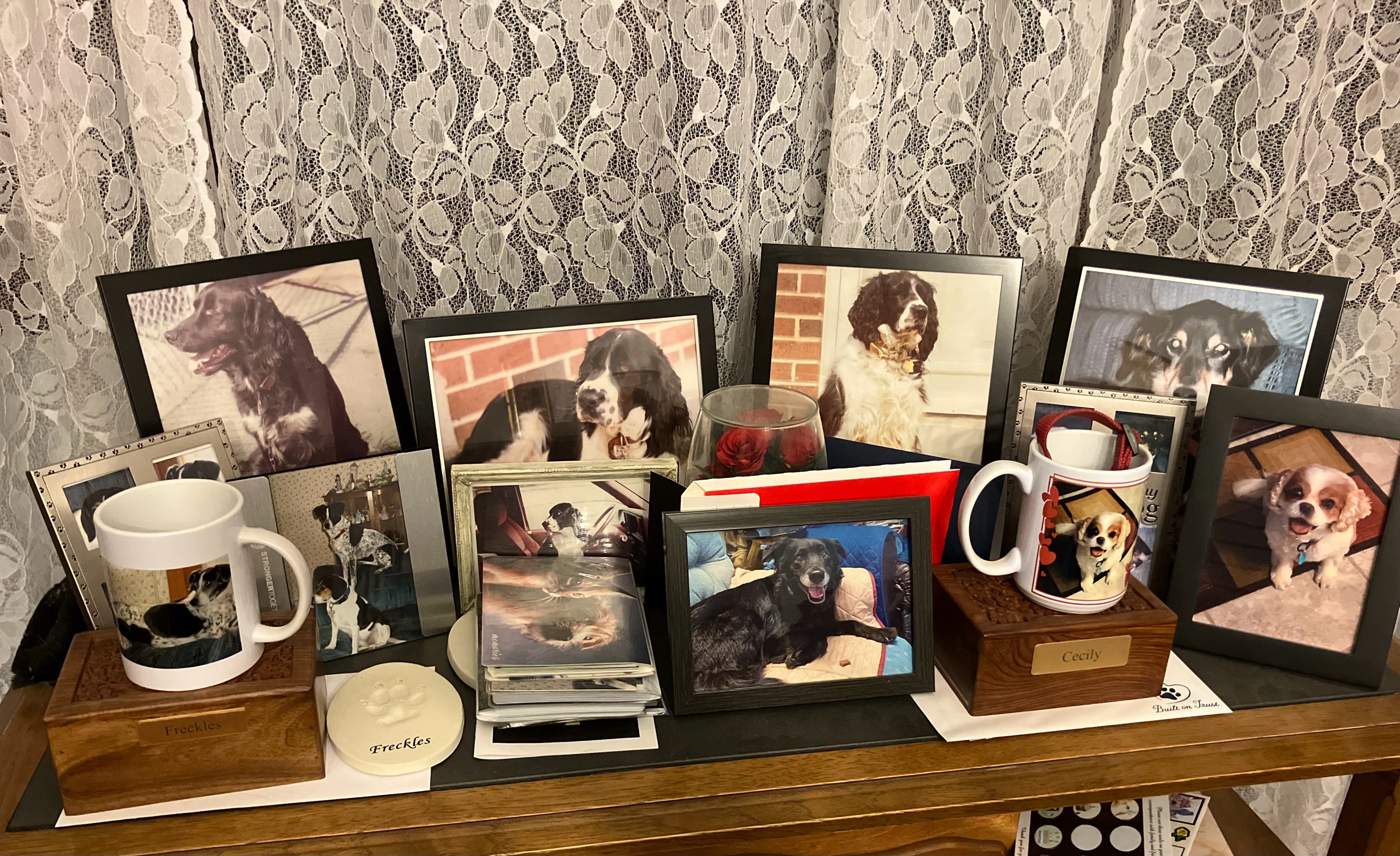
A tribute to all the dogs that have been in my life.
I wandered alone for a long time, but it wasn’t always so. I have vague memories—little scraps of images—from the past: the tumble and tussle of warm fur, the shimmer of sun on my brother’s back, the freckles on my sister’s snout. We were given away, placed in a box in a grocery store parking lot and given to anyone who would take us. We were held up, cooed over, and carried off under people’s arms.
The person who took me changed his mind when I grew larger. He tied me up in the backyard for months—with intermittent water and food—and then took me on a car ride and left me on the side of the road. I fended for myself then. Sometimes I was thirsty, sometimes I was cold, often I was hungry.
This morning, a man saw me, stooped down, and called to me. I watched him warily and then darted away. I have trouble trusting people. He left and then came back, carrying a bowl that smelled good. He sat quietly beside the bowl and I approached carefully, then backed away, then approached again. With one last sideways glance at the man, who looked at me calmly, kindly, I stretched my neck toward the bowl and began to eat. The man reached out and stroked my fur, first tentatively, then steadily. When he slipped a lead around my neck, he bent down to my level and said, “Come with me; we will find you a home,” I go with him, to the first warmth and comfort I’ve known in a long time.
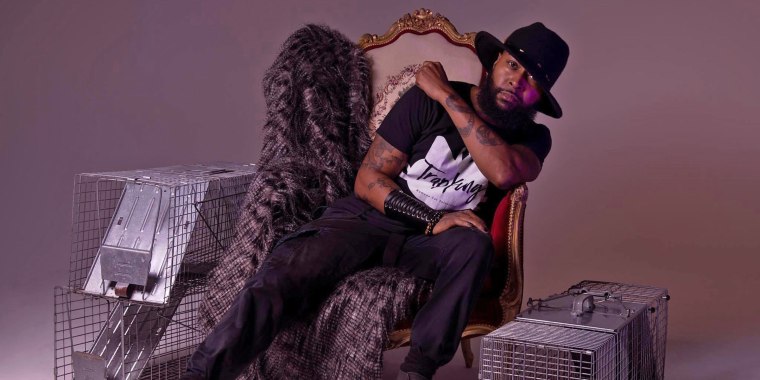
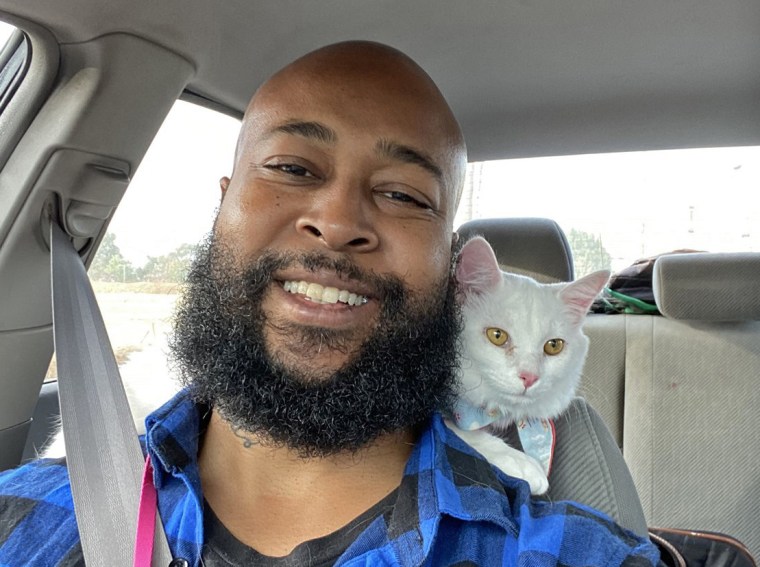
Atlanta resident Sterling Davis was on a break from a rap tour when he applied for a job at the county shelter scooping kitty litter. He just wanted to stay busy and make a little money. Plus, he’s always loved animals, like his cat at the time, Rick James.
“I did horrible in the interview because they had cats in the room and I was playing with all the cats, kissing all the cats,” he told Today.
Even though he didn’t really answer any of the questions because he was distracted by the friendly felines, he got the job because, as the person who hired him said, “We’re not seeing people like you with cats.”
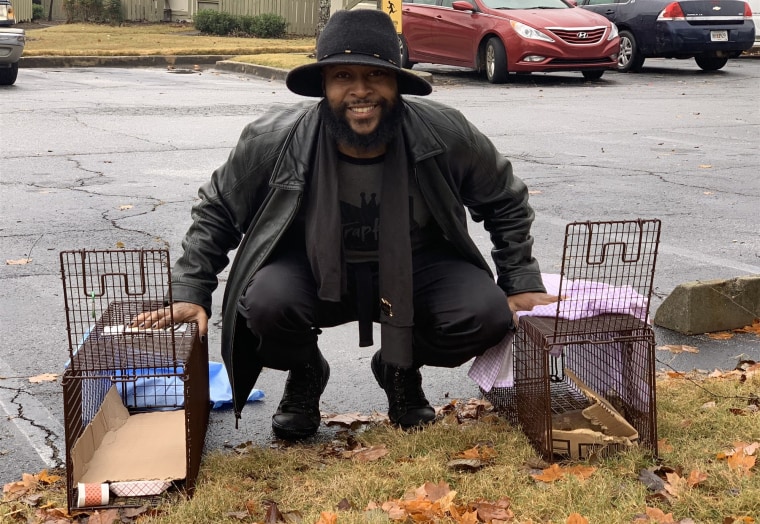
Davis, 40, started helping shelter employees with trap-neuter-return cases. The team would trap community cats (formerly called “feral”), bring them to the shelter to be vaccinated and spayed or neutered, and then return them to their outdoor realm.
While Davis learned about TNR, he came to another realization.
Most community cats wouldn’t do well inside a home, so trap-neuter-return is the humane alternative to euthanasia. TNR also reduces feline overpopulation, curbs the spread of disease and helps with rodent control.Courtesy of Sterling TrapKing Davis
“At the county shelter, there were no men and no Black people that worked in the cat department,” he said. “When I would go out and do TNR with all my friends, it would be all women — that’s who trained me. I finally asked the difficult question: ‘Where are all the guys and where are all the Black people?’’
The answer: There’s just you.
Davis realized he had a new calling. He let his band know he would not be coming back on tour. Instead, he was going to devote all his time to cat rescue as the TrapKing.
His bold goal: to change stereotypes of men in cat rescue and bridge the communication gap between Black communities and predominately white animal welfare organizations.
“I’ve seen rescue be something that’s looked at as hard, tedious, sad,” he said. “If people can see me and I make this look like this is a rock-star type life, this is fun — you can do it.”
When his music money dried up, Davis sold everything he owned and bought a conversion van to live in to help pay for cat surgeries and support his nonprofit. He plastered the van with TrapKing logos and people started noticing. He hosted contests for kids, who would watch his humane traps. Whoever texted him first about a cat in a trap won $20, second place got $15 and so on.
Sterling Davis has always loved cats. “They’re pretty amazing creatures,” he told TODAY. Courtesy of Sterling TrapKing Davis
“I started going into neighborhoods and kids would see me like the ice cream truck,” he said with a chuckle. “I would pull into apartment complexes and see young boys running up to the van trying to give me cats. ‘Hey Trap, look — I got a cat. Do I get some money?’”
As the TrapKing became better known, opportunities arose. The Atlanta Humane Society offered to spay and neuter cats he brought for free, which was a huge help since he wasn’t charging anyone for his services.
Davis, who enlisted in the Navy right out of high school and served for two years as an operations specialist manning the ship’s radar, said he believes his experiences have helped him connect with people from all walks of life as the TrapKing.
“I think being in the military, being around different people, different cultures and being in entertainment is what actually helped me better communicate with all types of people and better communicate this mission,” he said. “I’ve literally been pushing to make TNR community cat care as common as recycling and get more people engaged in so many fun ways.”
It hasn’t always been easy. Early on when Davis was returning cats to a predominately Black neighborhood, a group of men walked up and told him: “White people put tracking devices and diseases in these cats to hurt the Black community and you’re helping that. You’re bringing them into the neighborhood.”
“I was like, ‘Wow, that’s so wrong.’ It was really difficult to explain it because all the Black community could see was this is a white person’s thing,” he said.
Over time, perceptions have changed. When protests erupted across America in the wake of the killing of George Floyd, Davis launched a T-shirt campaign called “Allies in Rescue, Allies in Life.” He announced he would donate all of the funds to the nonprofit Campaign Zero, which promotes policy changes to end police violence. Support from rescue advocates and organizations was overwhelming.
“I got a lot of feedback from the Black community on that, like, ‘So you got all of these animal people to donate to issues other than just cats or dogs?’” he recalled. “I’m like, ‘Yeah — we’re allies in rescue and allies in life.’ So that really turned a lot of things around.”
A few months ago, Davis was setting a trap for a cat that surprised him by jumping into his arms. He adopted her and named her Alanis Mewissette. Courtesy of Sterling TrapKing Davis
Davis now runs TrapKing Humane Cat Solutions from an RV, which he shares with his cats Bowie, Damita Jo and Alanis Mewissette. He hopes to travel across the country soon promoting TNR and fundraising for animal shelters. He’s also pushing for the Boy Scouts and Girl Scouts to start offering a TNR badge.
Through it all, he’s continuing his outreach to communities and modeling his motto, “You don’t lose cool points for compassion.”
“I’ve had a lot of parents reach out to me and say that their son gets made fun of because he likes cats,” he said. “I just want it to be known that you cannot lose cool points for compassion. If you are doing something compassionate, you gain cool points.”
The TrapKing would love to see the rescue community find ways to put aside any differences and work together toward the common goal of saving the lives of pets.
“I think something as selfless as rescue could be an example to the world of unity and working together,” he said. “So I want to put that out there.”
Sam Wilson is a volunteer at https://www.facebook.com/GeorgeShelterCrete/ She is a former police inspector with Nottinghamshire, England police. She served on the force for 30 years and retired in September 2020. A week later, she flew to Crete, Greece to volunteer with George Orfanidis and his George Stray Dogs organization. Sam’s plan was volunteer for four weeks, improve her Greek language skills, and then return home. The return-home part of her plan became complicated. Her time there inspired her to book three additional flights to Crete over the following two months, with more planned in the future. Sam now has a very long commute to work and works side by side with George.
George Stray Dogs was founded by George Orfanidis, who has devoted more than 20 years to rescuing and caring for dogs and bringing about positive change for animals by changing people’s minds and hearts through education. George houses 100 dogs at his shelters, which lack electricity and water supply. Every day, without fail, he drives the 70 km round trip bringing water and food to the dogs.
Animal welfare is not a priority in Greece. There are estimated to be 8 million stray dogs and cats in the country. They are routinely abandoned in the rubbish, in the mountains, and on the street. Some dogs are chained to barrels for the length of their lives, with little food and fresh water, and riddled with ticks, fleas, and worms.
George has been reliant on his fellow Greeks for donations for food for veterinary medicine, but Greece has been in recession for a long time. Many of the people who care about animal welfare have little money to give. The struggle for funding was somewhat alleviated when Australian animal activist Stella Savvas set up the organization’s Facebook page. George has also received various volunteer assistance from his brother Nikos Orfandis, and volunteers Katerina and Debra. The organization also received a boost when George’s friend, well-known Greek rescuer Takis Proestakis, mentioned him on his FB page.
The access to a wider audience has allowed George to build infrastructure at one of the shelters, which will allow all of the dogs to be housed at one site. Fencing, kennels, and easy access to water will make the rescue work easier. George, Sam, and other volunteers are currently working to complete the site work before winter sets in.
Some of George Stray Dogs rescue success stories – Before and After:
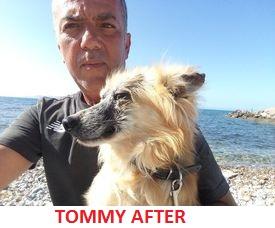
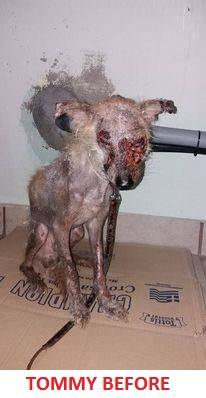
Tommy – George found Tommy in the filth of an abandoned house. The sight of Tommy reduced George to tears. Tommy had little fur and wounds all over his face and body from the effects of leishmaniasis, a parasitic disease which afflicts many dogs in the southern Mediterranean. After months of care, love, and treatment, Tommy was transformed into a beautiful dog. Tommy and George are now inseparable.
Hara – Hara was abandoned in the rubbish five years ago. George was caring for her as a stray on the streets. One day, he was alerted that some men had her on a chain and were ready to hang her. George went to the location and fought with the men to save her life. (He has been attacked more than one occasion for his work.) The men damaged George’s car and bruised him, but Hara was saved and she now lives at the shelter. Hara is a contented dog with a sweet and gentle nature. The deformed leg with which she was born causes her no issues.
Dias – Dias is known as the Gentle Giant. He is a 60kg Greek Shepherd found on the highway with shattered legs, unable to move. With two surgeries and care from George he is thriving. The puppies particularly adore him. He’s the alpha dog in his pen but calm and even natured with others.
The transformation of dogs from when they arrive at the shelter in heart-breaking condition to health, balance, and friendly dispositions. They form close bonds with each other and adore George. George has a huge heart, dedication, and deep compassion for the neglected, abused, abandoned, tortured animals on Crete, Greece.
If you would like to make a donation to George Stray Dogs, their Paypal account is
A vacationing businessman was walking along a beach when he saw a young boy. Along the shore were many starfish that had been washed up by the tide and were sure to die before the tide returned.
The boy walked slowly along the shore and occasionally reached down and tossed the beached starfish back into the ocean. The businessman, hoping to teach the boy a little lesson in common sense, walked up to the boy and said, “I have been watching what you are doing, son. You have a good heart, and I know you mean well, but do you realize how many beaches there are around here and how many starfish are dying on every beach every day. Surely such an industrious and kind hearted boy such as yourself could find something better to do with your time.
Do you really think that what you are doing is going to make a difference?
The boy looked up at the man, and then he looked down at a starfish by his feet. He picked up the starfish, and as he gently tossed it back into the ocean, he said, “It makes a difference to that one.”
Spuds the cat and Ollie the dog watch from the hearth rug as Aunt Joan rolls out the dough with her grandmother’s rolling pin. She smooths butter on the dough, sprinkles it generously with cinnamon and brown sugar, rolls it up, and pops it into the stove. Outside it’s dusk. Snow is falling.
Tori comes into the kitchen, inhaling deeply. “Umm. What’s cooking?”
“Mouse. Your great-grandmother used to make it from the leftover dough from her pies. Did your mom make it?”
“I don’t think so. I don’t remember. Come on, Ollie. Let’s go feed the barn animals.” She motions for him to follow her.
Ollie sighs, reticent to leave the warmth of the kitchen, and rises. He follows Tori out the door, squinting his eyes to a gust of snow that swirls off the roof. They walk toward the barn. In the hills there glimmers the twinkling of lights of other farms. Tori looks up at the sky and sticks out her tongue to catch snowflakes.
They walk to the barn through the mounting snow. The donkey, Frank Sinatra, shakes his mane and the horse, Fred, whinnies in greeting. Tori pats them, gives them fresh water and hay and some extra grain, because it’s Christmas Eve. The chickens, which roam in the relative warmth of the barn, come over to them, clucking softly. Ollie noses them gently. Tori stoops down and runs her palm over their feathers, murmuring to them. She gives them extra feed and adds more hay to their nest for warmth.
They listen to the soft munching of the horse and donkey, the gentle clucking of the chickens. Tori closes the door and they step out into the snow, which has covered their footsteps leading to the barn. Stars have started to emerge, little pinpricks of light in the dark blue sky. The farmhouse roof is draped with snow, and each window is aglow with candles. Through the steamy kitchen window, Aunt Joan takes cookies from the oven. Through the living room window, Uncle Jon lights candles nestled in pine boughs on the mantle. Spuds follows Aunt Joan into the living room and sits beneath the Christmas tree. Uncle Jon turns toward Aunt Joan, laughing at something she says.
Ollie looks up at Tori beside him, who reaches down and scratches him behind his ear. Then they trudge through the snow together. At the doorway she dusts the snow off of Ollie’s back and kicks the snow off of her boots. They enter the house, which smells of pine and baking, and join the family.
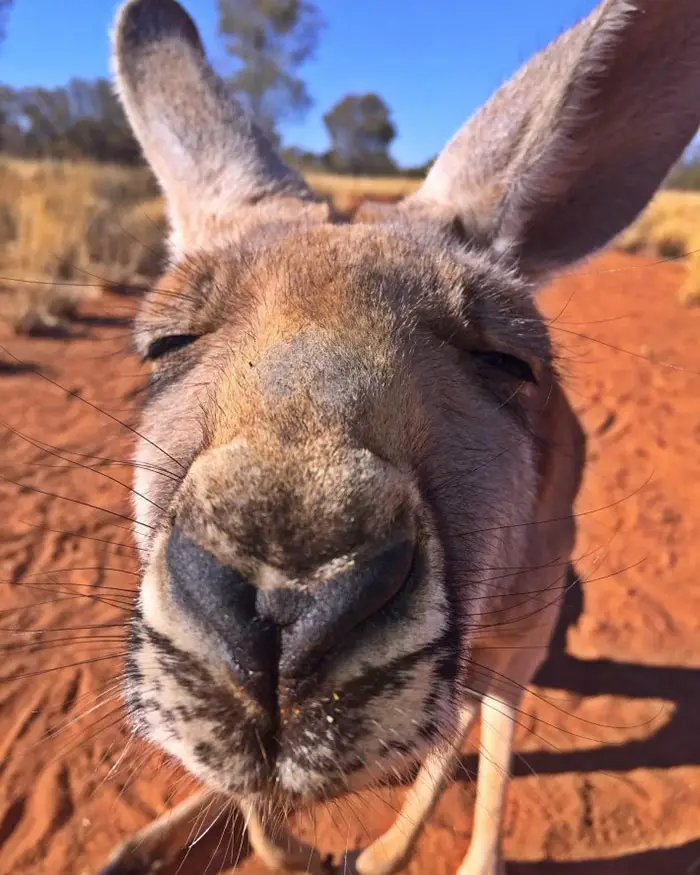
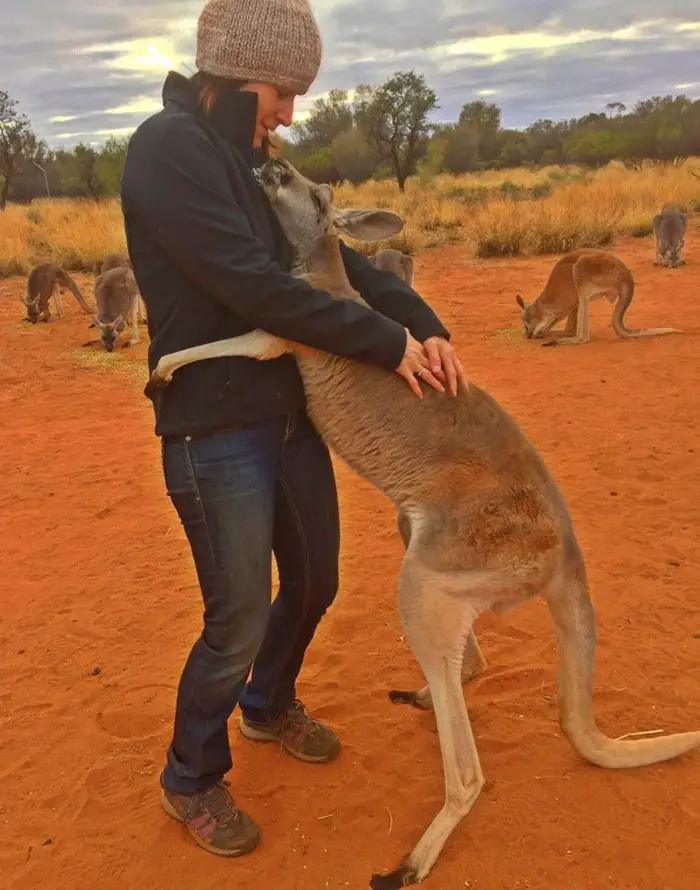
(See the video link of hug-in-action at the end of this post) Just like human beings, animals have feelings, too – there’s no doubt of it. Especially when it comes to those who take care of them, or more people who saved their life. And probably the best example it’s the story of Abigail, one of the most affectionate rescued animal in the world.
When she was just a few months old, the poor little kangaroo lost her mom. It’s when she arrived at the Kangaroo Sanctuary Alice Springs in Australia. Here she was welcomed with the open arms and a lot of love by the volunteers. Of course, the little one responded with the same coin and now, ten years later, hugging those who rescued her and took care of her became part of her daily routine.
Due to her friendly, lovely attitude, Abigail earned the tittle of the sanctuary’s “Queen.” And now, all the staff at the centre start their day with a warm hug from Abi.
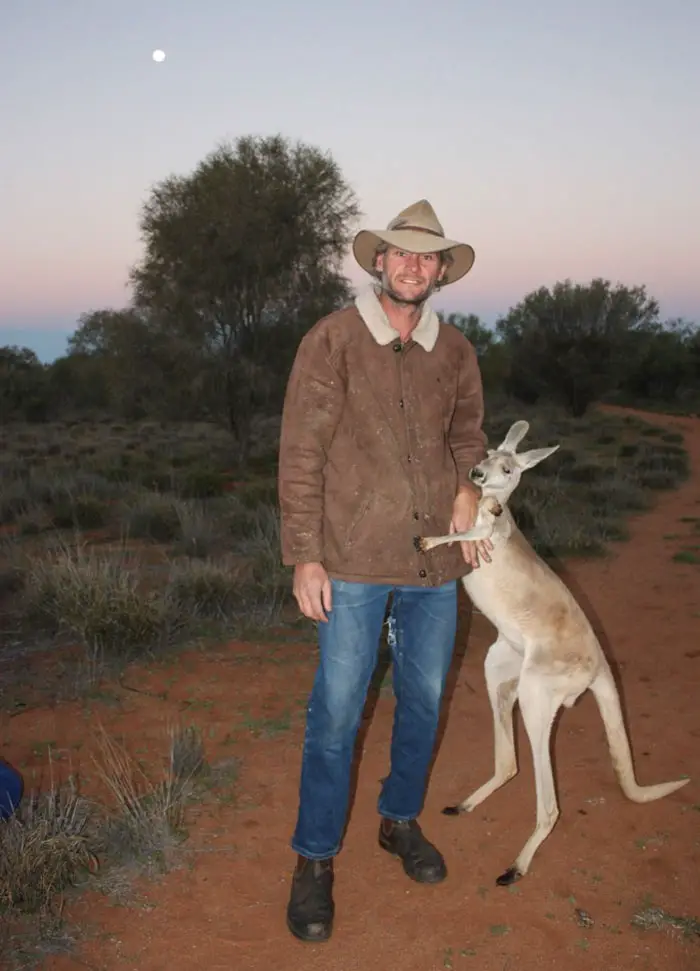
“Abi was raised from a joey with Roger and Ella…Abi came to me as an orphan of 5 months old and was quite busted up with cuts and scrapes. Abi has grown into a very healthy 7 year old, and is my only kangaroo who comes up and gives a great big rugby tackle cuddle. Abi is also unusually light in colour and I think she is very beautiful,” wrote the Sanctuary Alice Springs on their Facebook page.
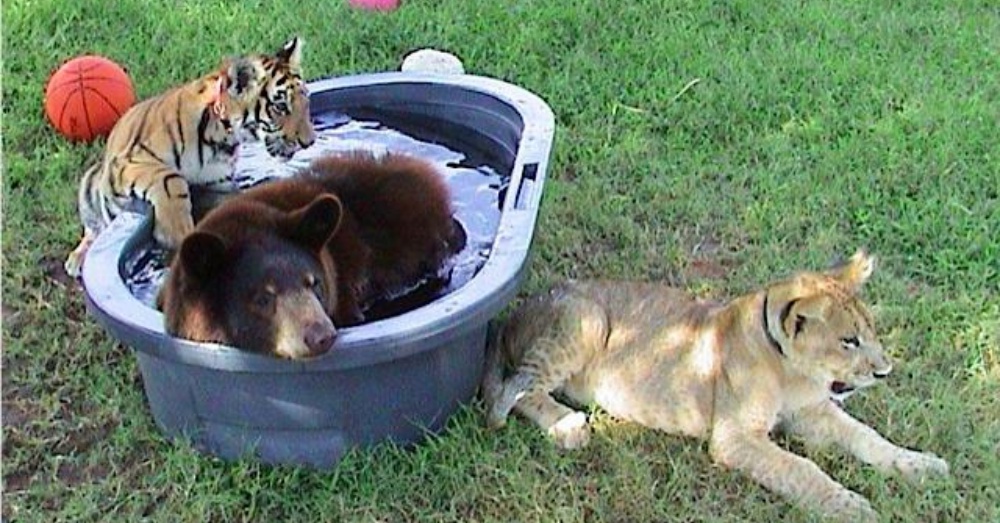
Lions, tigers, and bears definitely aren’t meant to live as a pack. But not every animal has been through the trauma that forged the bond between three normally opposing male predators.
Back in 2001, police raided a drug dealer’s house in Atlanta, Georgia. In the basement, they came across a heartbreaking sight. There sat three terrified, malnourished, and parasite-ridden cubs that certainly didn’t belong in anyone’s home.
Photo: Facebook/The BLT – Baloo, Leo and Shere Khan
The African lion, Leo, had been stuffed inside a small crate with an open wound on his face. Shere Khan, the Bengal tiger, was emaciated, and the black bear, Baloo, was wearing a harness so small it had become embedded into his flesh.
But their nightmare was finally over; the Georgia Department of Natural Resources took them to Noah’s Ark Animal Sanctuary, a nonprofit animal rescue in Locust Grove. There, they’d spend the rest of their days on a beautiful 250-acre property. They’d already been through too much in their short lives to ever be released back into the wild.
Photo: Facebook/The BLT – Baloo, Leo and Shere Khan
“When they were first brought to the sanctuary, Baloo, Shere Khan, and Leo were injured, frightened and clinging to one another for comfort,” curator Allison Hedgecoth told HuffPost. And as they got more comfortable, they groomed each other, cuddled, and played together. Clearly, they were a bonded trio.
Photo: Facebook/The BLT – Baloo, Leo and Shere Khan
Sanctuary staff anticipated the need to separate the friends once they reached sexual maturity, as they would likely grow apart. After all, it’s the natural order in the animal kingdom. But the trio, known as BLT (bear, lion, tiger), never left each other’s sides. The sanctuary ultimately decided to keep them together.
Photo: Facebook/The BLT – Baloo, Leo and Shere Khan
For 15 years, Baloo, Leo, and Shere Khan lived, slept, and ate in the same habitat. And after surviving such horror together, they couldn’t have been happier.
Photo: Facebook/The BLT – Baloo, Leo and Shere Khan
Baloo, the playful one, loved teasing Leo with gentle bites. And the affectionate Shere Khan could often be found snuggling up to either of his brothers.
“Even though they live in a three-acre enclosure, they’re usually within 100 feet of each other,” Allison told Inside Edition. “That’s proof that they’re not just coexisting or cohabiting, they actually do enjoy each other’s company.”
Photo: Facebook/The BLT – Baloo, Leo and Shere Khan
Leo and Shere Khan spent the rest of their lives with Baloo before they passed away, respectively, in 2016 and 2018. Baloo was there for both of their burials — and a constant presence in their final days.
Photo: Facebook/The BLT – Baloo, Leo and Shere Khan
While everyone at the sanctuary is still heartbroken over their deaths, they find solace in knowing they gave all three a fantastic life together. And they’re making sure Baloo knows he isn’t alone.
Photo: Facebook/The BLT – Baloo, Leo and Shere Khan
Rest in peace, Leo and Shere Khan. The world will never forget your beautiful story of survival and friendship.









 Untold Animal Stories