
View on substack: https://thekindlife.substack.com/p/the-dog-who-knew-340-words
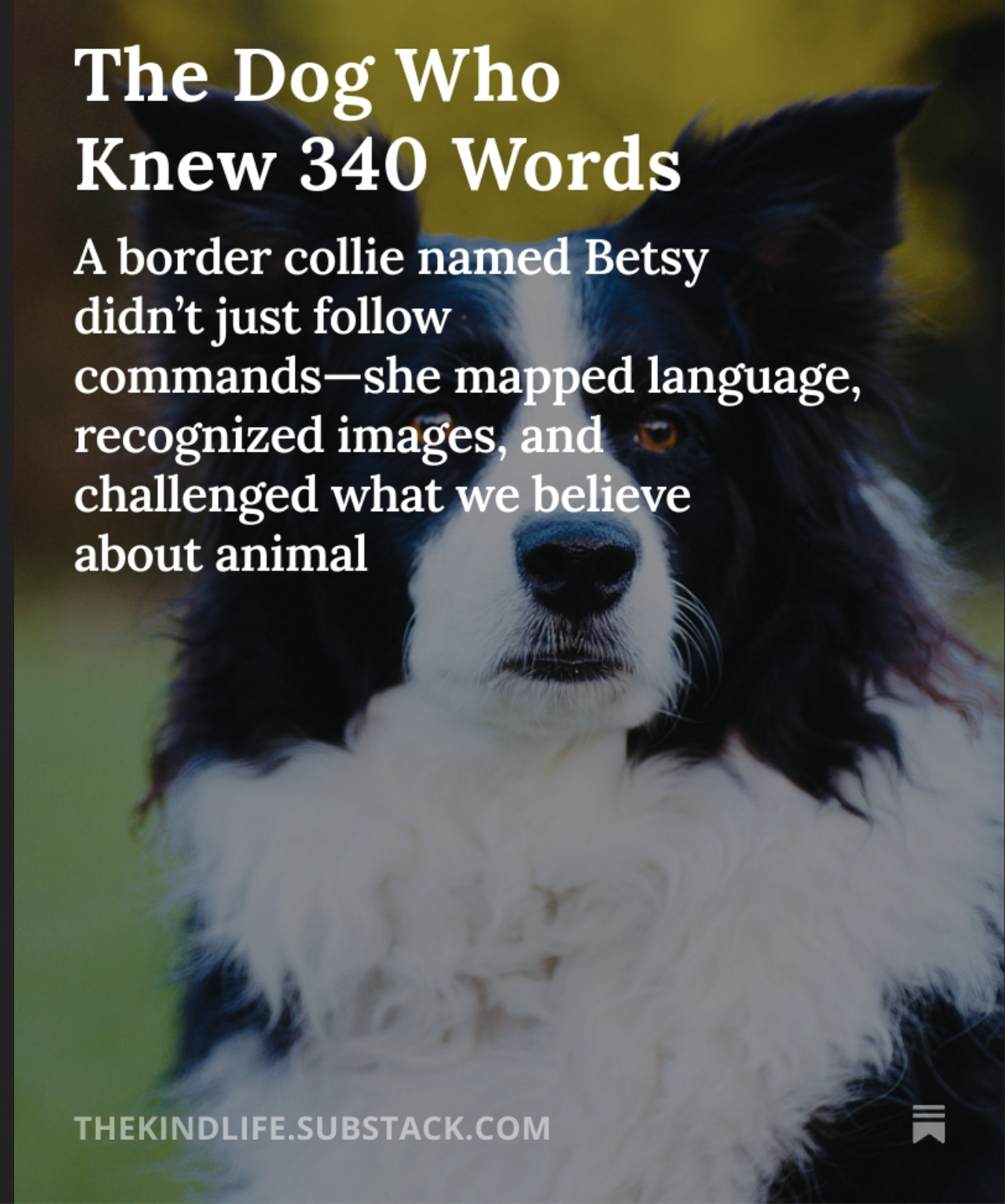
Betsy, a border collie in Vienna, was the kind of dog who made people rethink what they believed about animal intelligence. She demonstrated an understanding of more than 340 words. Beyond simply responding to commands, she was able to connect words, objects, photographs, and memory in a way that is language‑like.
Betsy was thought to learn in a similar way to how human toddlers learn through what’s known as fast mapping. This rapid process involves roughly determining or guessing a word’s meaning through context and through contrasting it with already-known words after minimal exposure (in Betsy’s case, generally twice). Over time, Betsy fine-tuned that guess, through repetition and other input, into a more complete understanding (as do toddlers).
Betsy’s feats also included visual abstraction: she recognized photographs as representations of real objects, even unfamiliar ones. In controlled tests, she selected the correct item 38 out of 40 times when presented with an array of 7 physical objects for each photograph. The probability of attaining that level of success repetitively in 1 out of 7 odds is 1 in 200 quintillion billion. Betsy remembered the connections weeks later.
Featured on the cover of National Geographic, Betsy was instrumental in gently unsettling old assumptions. Dogs are often praised for loyalty and obedience, but Betsy hinted at something else too: the ability to learn in a way that resembles thought—something flexible, curious, and deeply adaptive. When people insist that animals operate purely on instinct, cases like Betsy’s expose those assumptions as more self‑serving than scientific.
The way we see animals’ minds is closely tied to how we treat them. When one is convinced that animals are incapable of complex thought, feelings, or durable memory, it becomes easier to justify their neglect, confinement, or misuse. Betsy’s abilities—her fast mapping, grasp of images as symbols, and lasting associations—remind us that other minds may be watching, interpreting, and remembering far more than we may care to admit. Her behavior contributes, in a quiet but powerful way, to dismantling the myth that “lower” animals are too simple to warrant real ethical consideration. By showing that meaning can be constructed, stored, and reused, Betsy unwittingly pushes us to ask: if this dog could learn so deeply, how many other animals are silently bearing scars we never intended and suffering due to our ignorance?
Thoughtful, weekly stories about animals:
Compassion in Action: Instead of unthinkingly eating a piece of meat, pause and consider what that animal likely endured on its journey to your plate. Ask yourself whether you’re willing to continue contributing to a system where demand drives more suffering.
 Untold Animal Stories