Elephant Mourning

Elephants have vigils and rituals for their dead. A glimpse into animal emotions.
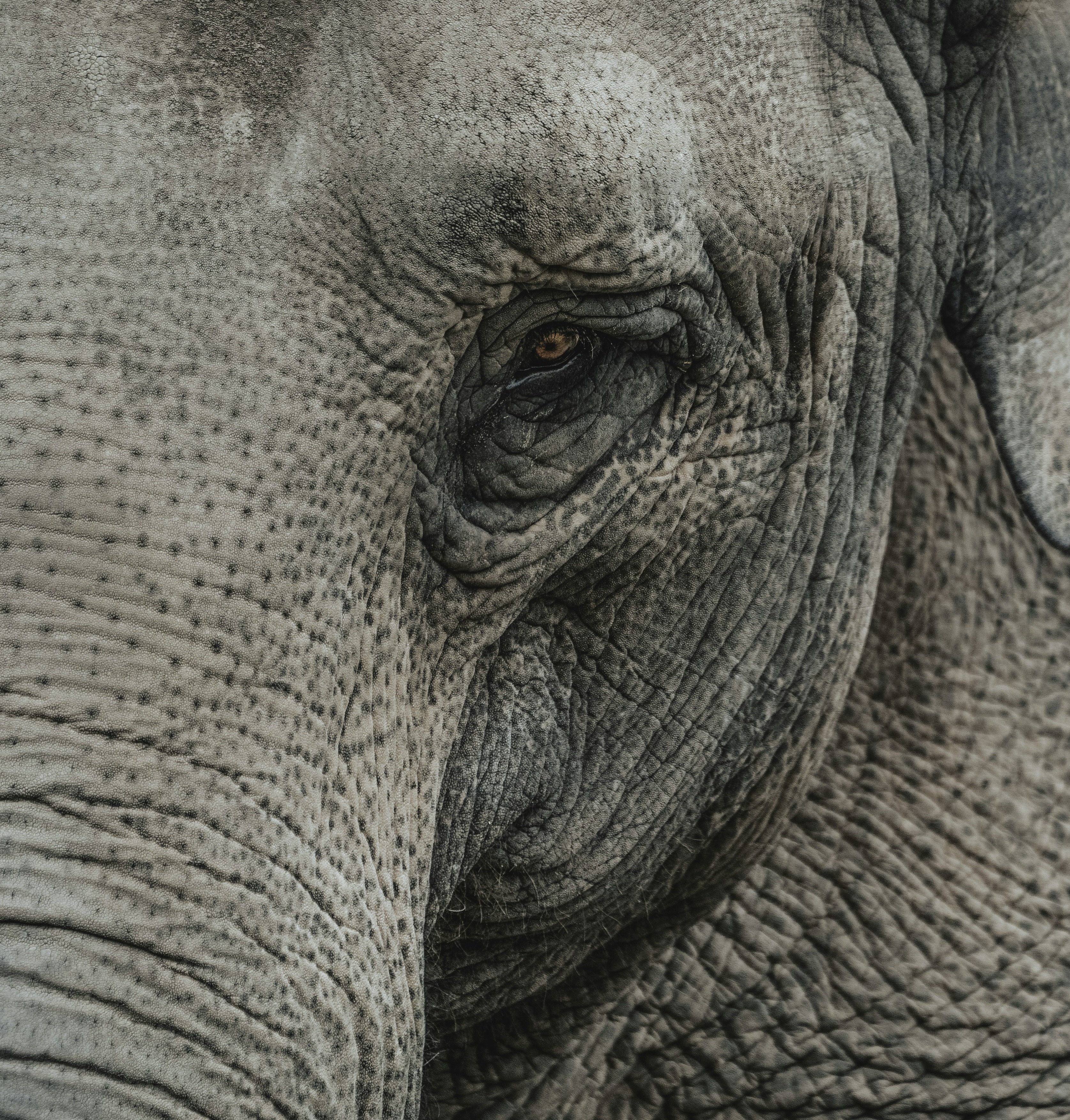
Field guides, trackers, and researchers have seen it again and again: Elephants do something extraordinary when they pass the body or remains of another elephant—they stop, become still, and then gently and slowly caress the elephant with the tips of their trunks. They emit low rumbling sounds and distress calls. They drag over branches or tear up grasses and cover the carcass gently. They do this ritual even if the elephant was not part of their herd. Elephants show no interest in the carcasses of other species.

When they come upon a dying elephant, their behavior is more active, protective, and interventional. They try to lift and prop up the elephant, clustering around it and bracing it front and back to keep it upright. They trumpet and roar and guard the dying elephant—some facing outward and some tending the elephant.

Mother elephants are at the heart of some of the most haunting accounts of elephant grief. Researchers and rangers describe elephant cows staying with a stillborn or dead calf for days, trying desperately to lift and nudge the body. An Asian elephant near Tumkur, India, was recorded jostling her lifeless calf for more than 24 hours, her ears fluttering in distress. A group of 12 adults gathered around her, apparently trying to console her. In multiple documented cases, mothers have lifted dead calves with their trunks and carried them for days.

Scholars of animal sentience, such as Marc Bekoff, Frans de Waal, and Jonathan Bird, argue that the question is no longer whether animals feel, but why sentience evolved—and why we keep doubting it. Their point is disarmingly simple: if an animal screams when injured, plays when safe, and shows every outward sign of distress when its young dies, insisting we “need more data” before acknowledging its experience becomes less about scientific caution and more about moral convenience. Elephants—with their vigils, their bone caresses, and their attempts to care for a dying tribe member—push that discomfort to the surface.

When an elephant stands over the bones of a long-dead companion, falling into stillness and tracing the skull with her trunk, she invites us to widen our circle of empathy—and to admit that grief may not be ours alone. We can choose to label that behavior as mere instinct, or we can acknowledge that we are watching another intelligent, deeply social species grapple with loss in its own way.

Loved this glimpse into nature’s wonders? Subscribe for weekly insights on animals, empathy, and living thoughtfully. https://bit.ly/4cIP06h

Share

Do Animals Think & Feel?

Read on Substack https://thekindlife.substack.com/p/do-animals-think-and-feel

Ask anyone who lives with pets whether animals think and feel, and they’ll likely raise an eyebrow, privately wonder whether you’re nuts, and answer, of course they do. Over time, more and more researchers have come to agree.

Not long ago—by that I mean the late 20th century—the widely held belief was that animals were incapable of thought and emotion and only reacted mechanistically to stimuli. The foundations of this are traceable in part to 17th century philosopher René Descartes who posited that nonhuman animals were “automata”—complex biological machines devoid of reason, thought, consciousness, sentience, and feeling. Their cries, for example, were machine-like reflexes and pre-programmed responses to stimuli rather than indicative of pain or feeling.

Religion, moral convenience, and psychological and social factors have played a role in this thinking and have justified a comfortable status quo. Christianity, Judaism, and Islam religions believe that humans are uniquely made in the image of God. Only humans possess souls, so goes the thinking, and animals lack inner experience, rational thought, and the ability to feel genuine emotion and pain. There’s a psychological incentive to downgrade or deny animal cognition and sentience and to dismiss animal suffering as robotic reactions—it makes eating meat, animal experimentation, and the cruel practices of factory farming much less troublesome.

For years some scientists and philosophers contended that since animals couldn’t use language to report their inner experience, its existence couldn’t be scientifically validated and therefore should not be assumed. In the early and mid-20th century, strict behaviorists B.F. Skinner and John B. Watson led a movement that focused on observable behavior, treated references to animal consciousness, feelings, and thoughts as scientifically meaningless, and confined research to measurable stimuli and response. For decades the study of animal sentience and concern about the ethical treatment of animals lay more or less dormant.

Over the last several decades, evidence from the disciplines of ethology (animal behavior), animal cognition and comparative psychology, neuroscience and neurobiology, evolutionary biology and psychology, and cognitive science has made it harder to maintain the belief that animals do not think or feel. Researchers began designing experimental methods yielding strong and converging evidence that animals think (demonstrating flexible, goal-directed cognition) and feel (have conscious experiences such as fear, pain, and pleasure). Experiments with diverse mammals and nonmammals (including insects) have shown that various animals can solve problems, plan ahead, remember past events, recognize individuals and self, use tools, display grief, joy, jealousy, empathy, and fairness, and exhibit metacognition (knowing that you don’t know). Brain imaging and neurophysiology have shown a biological continuity between humans and animal brain structures and activity patterns linked to emotion, pain, and consciousness.

A number of scientific groups and conferences have issued statements on animal cognition and sentience. For example, the University of Cambridge Declaration of Consciousness (2012) states that nonhuman animals, including mammals, birds, and sea creatures, have the neurological substrates for consciousness. The New York University Declaration on Animal Consciousness (2024), signed by 500+ scientists, affirms strong support for conscious experience in mammals and birds, and a realistic probability in all vertebrates and in many invertebrates (cephalopods, crustaceans, insects), and urges welfare considerations.

Marc Bekoff, Professor Emeritus of Ecology and Evolutionary Biology, University of Colorado at Boulder, states in his book The Emotional Lives of Animals, “Human beings are a part of the animal kingdom, not apart from it. The separation of ‘us’ and ‘them’ creates a false picture and is responsible for much suffering.”

Intermittently I’ll be writing articles summarizing research findings and providing anecdotal stories about animal cognition and sentience. Stay tuned!

Do you have any personal stories about something an animal did that gave you a window into their thinking? If so, I’d love to hear it.

Compassion in Action:

The next time you are about to buy factory-farmed meat (which is what is sold in virtually every grocery store), consider what that animal likely endured and whether you feel comfortable supporting a large-scale industrial system that prioritizes efficiency and profit over animal welfare. For meat eaters, an alternative is to look for labels that say sustainably raised, locally raised on pasture-based farms, humanely raised, free-range, or Certified Humane, or contact a butcher who will likely know of local farmers who raise animals.

Read on Substack https://thekindlife.substack.com/p/do-animals-think-and-feel